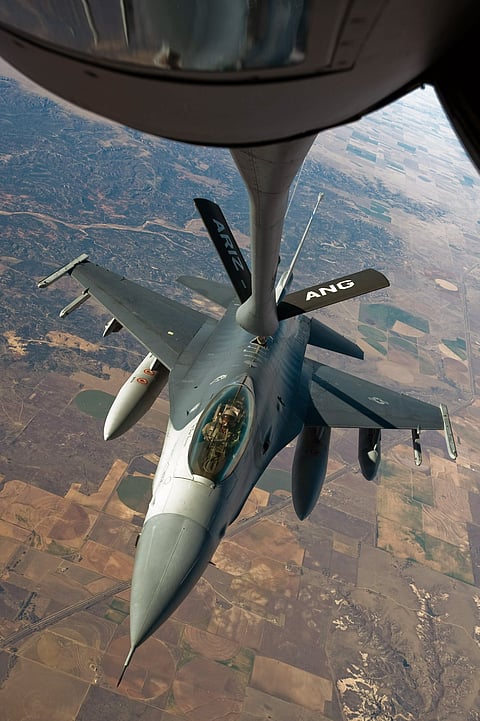


A commercial passenger aircraft narrowly avoided a midair collision with a U.S. Air Force aerial refueling tanker on Friday while departing from the island of Curaçao, according to a statement released by airline operator JetBlue.
JetBlue confirmed on Sunday that Flight 1112, an Airbus A320 operating a scheduled service from Curaçao’s Hato International Airport to New York, encountered the military aircraft shortly after takeoff. While climbing through Curaçao’s airspace, the flight crew observed a U.S. Air Force tanker crossing their flight path at the same altitude.
The pilots immediately halted their climb to avoid a collision, later describing the incident as a “near midair collision” in communications with air traffic control. According to pilot communication logs, the crew reported that the military aircraft’s transponder was turned off, rendering it invisible on standard cockpit instruments and air traffic displays.
In recorded communications, the JetBlue pilots directly criticized the tanker for operating without an active transponder and stated that the aircraft appeared to be “heading northeast into Venezuelan airspace.” Curaçao lies approximately 40 miles (60 kilometers) north of the Venezuelan coast, placing the incident within a region of heightened U.S. military activity.
JetBlue stated that it has formally reported the incident to federal authorities and will cooperate fully with any investigation. In its statement, the airline said, “We have reported this incident to federal authorities and will participate in any investigation. Our crewmembers are trained on proper procedures for various flight situations, and we appreciate our crew for promptly reporting this situation to our leadership team.”
The U.S. military and government have not publicly commented on the incident.
The near collision occurred amid an increase in U.S. military operations in the southern Caribbean. On Friday, at least two U.S. Navy F/A-18 Super Hornets were observed conducting patrols southwest of Aruba, Curaçao’s neighboring island. These patrols have taken place increasingly close to Venezuelan airspace in recent weeks.
Tensions in the region have continued to rise as Washington expands its military presence near Venezuela. Last week, U.S. President Donald Trump suggested that operations against targets inside Venezuela could begin under the framework of a counter-narcotics mission. Such statements follow nearly four months of military deployments to the region, which have coincided with escalating political pressure on the government of President Nicolas Maduro.
The incident has raised questions about coordination between military and civilian aviation in congested airspace, particularly in regions experiencing heightened military activity. Aviation safety experts have long warned that operating military aircraft without active transponders near commercial flight corridors increases the risk of serious accidents.