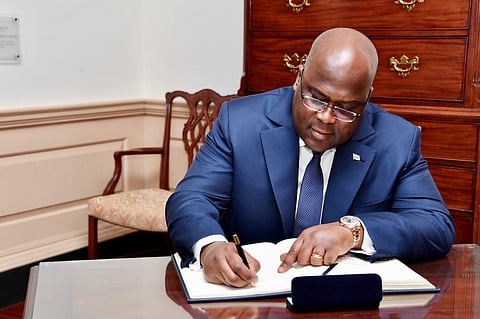


Democratic Republic of Congo President Felix Tshisekedi accused Rwanda on Monday of violating a U.S.-brokered peace agreement signed only days earlier in Washington, claiming Rwandan forces fired heavy weapons into Congolese territory the day after the December 4 ceremony.
The accord, signed by Tshisekedi and Rwandan President Paul Kagame and hosted by U.S. President Donald Trump, aimed to end decades of conflict in eastern Congo through troop withdrawal, disarmament of armed groups, and economic cooperation.
In an address to parliament, Tshisekedi said Rwandan army units based in Bugarama shelled the South Kivu localities of Kaziba, Katogota, and Lubarika, causing significant damage.
He described the actions as a direct breach of the ceasefire and reaffirmed Kinshasa’s commitment to the diplomatic process.
Rwandan Foreign Minister Olivier Nduhungirehe dismissed similar accusations from Congolese military sources as “ridiculous” and an attempt to shift blame.
Meanwhile, fighting continued in eastern Congo, with the M23 rebel group — widely accused by the UN, Kinshasa, and Washington of receiving Rwandan support, which Kigali denies — advancing toward the South Kivu town of Uvira near the Burundi border.
Local sources reported M23 seizing villages and heavy clashes around Luvungi and Sange that killed dozens.
Burundi’s Foreign Minister separately accused Rwanda of continued “destabilizing activities” and attacks on Burundian troops deployed in Congo, vowing no withdrawal until their mission is complete.
The U.S. State Department expressed deep concern over the violence, stating Rwanda must prevent further escalation, while a Trump administration official said Washington was monitoring compliance and expecting “immediate results.”
Despite the December 4 agreement being hailed as historic, multiple failed ceasefires in recent years have fueled skepticism about lasting peace in the mineral-rich but volatile region.