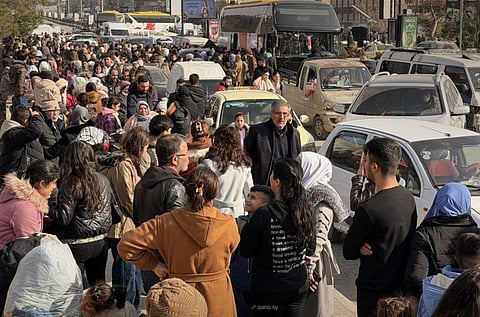


Clashes have resumed in the northern Syrian city of Aleppo following the expiration of a government-imposed deadline aimed at resolving the status of Kurdish-held neighborhoods. Syrian government forces and units linked to the Syrian Democratic Forces (SDF) exchanged fire on the outskirts of the Sheikh Maqsoud district, signaling the collapse of recent attempts to impose order without large-scale confrontation.
Soon after the clashes began, reports emerged of heavy artillery bombardment targeting Sheikh Maqsoud and the neighboring Ashrafiyeh district. Both areas are predominantly Kurdish and have long existed in a semi-autonomous security arrangement within Aleppo, a balance that now appears to be breaking down.
The renewed fighting follows a series of escalating measures by Damascus, including the declaration of Sheikh Maqsoud and Ashrafiyeh as closed military zones and the imposition of a full curfew. Civilians were urged to evacuate ahead of what authorities described as imminent security operations. The expiration of the deadline appears to have triggered a shift from pressure to direct military action.
Government statements have framed the operation as an effort to restore full state authority and eliminate what they describe as unauthorized armed presence. Kurdish authorities, meanwhile, have accused Damascus of abandoning negotiated frameworks in favor of coercion.
For years, Sheikh Maqsoud and Ashrafiyeh occupied a unique position in Aleppo. Even during the height of the civil war, the districts were governed by Kurdish local councils and defended by SDF-linked forces, operating under periodic understandings with the central government that limited direct confrontation.
Those arrangements were always provisional. Attempts to integrate Kurdish forces into national structures stalled repeatedly, and trust eroded as Syria entered its postwar transition. The current escalation suggests that Damascus is no longer willing to tolerate unresolved security zones inside one of the country’s most symbolically important cities.
The use of heavy artillery in densely populated urban districts has raised immediate concerns for civilians still sheltering in the area. Previous rounds of fighting in these neighborhoods resulted in casualties, infrastructure damage, and temporary blockades that restricted access to food and medical care.
With evacuation routes uncertain and movement restricted by curfews, residents face the prospect of renewed displacement in a city that has already absorbed waves of refugees over more than a decade of conflict.
What unfolds in Sheikh Maqsoud and Ashrafiyeh is being closely watched across Syria. Aleppo has become a proving ground for the country’s postwar order, a place where unresolved questions of autonomy, central authority, and armed power intersect.
The renewed fighting suggests that Syria’s transition remains far from settled. While large-scale frontlines have faded, internal fault lines continue to resurface, particularly where local governance and military control remain contested.
As the deadline gives way to artillery fire, the battle for Aleppo’s Kurdish districts highlights a central dilemma facing Syria today: whether consolidation will come through negotiation or force, and at what cost to a population already exhausted by years of war.