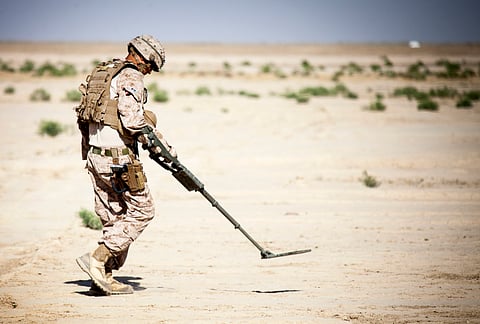


Finland has formally withdrawn from the Ottawa Convention, the international treaty banning anti-personnel landmines, completing a process it initiated in July last year. The withdrawal became effective on Saturday following the convention’s required six-month notice period. Helsinki had been a signatory since 2012, aligning its defense policy for more than a decade with global humanitarian disarmament efforts.
Adopted in 1997, the Ottawa Convention prohibits the use, production, stockpiling, and transfer of anti-personnel landmines due to their indiscriminate nature and long-term danger to civilians. During its participation, Finland destroyed more than one million such mines, retaining only a limited number for training purposes.
Finnish officials have justified the decision as part of a broader reassessment of national defense needs. President Alexander Stubb said in June that Finland faces “an aggressive, imperialist state” as a neighbor, while Defense Minister Antti Hakkanen argued that protection against the perceived Russian threat must take precedence over arms control commitments.
Russian officials have repeatedly dismissed claims that Moscow plans to attack NATO or European Union countries, describing such assertions as unfounded. The Kremlin has maintained that it has no interest in initiating conflict with Western states.
Finland’s withdrawal is part of a wider regional shift. Lithuania, Latvia, and Estonia have announced similar decisions, reflecting changing security calculations among NATO’s eastern and northern members since the escalation of the Ukraine conflict in 2022. These moves signal growing concern that existing arms control frameworks may not align with contemporary defense requirements.
The developments have drawn criticism from international institutions. UN Secretary-General Antonio Guterres described the withdrawals as troubling, warning that the erosion of humanitarian disarmament norms risks increasing civilian harm long after conflicts end.
Relations between Helsinki and Moscow have deteriorated sharply in recent years. Finland shares a 1,340-kilometer border with Russia and has provided political and material support to Ukraine. In April 2023, it joined NATO, ending decades of military non-alignment and reshaping the strategic balance in Northern Europe.
Kremlin spokesman Dmitry Peskov has said that Russia previously maintained stable and mutually beneficial relations with Finland and Sweden before their decisions to join the alliance. He has argued that Moscow was not responsible for the deterioration of ties and remained open, in principle, to pragmatic cooperation.
Finland’s exit from the landmine ban underscores a broader tension between humanitarian arms control and evolving security priorities in Europe. As the region adapts to a more confrontational geopolitical environment, longstanding disarmament commitments are increasingly being reassessed through the lens of deterrence and territorial defense, highlighting a period of transition in the post–Cold War security order.