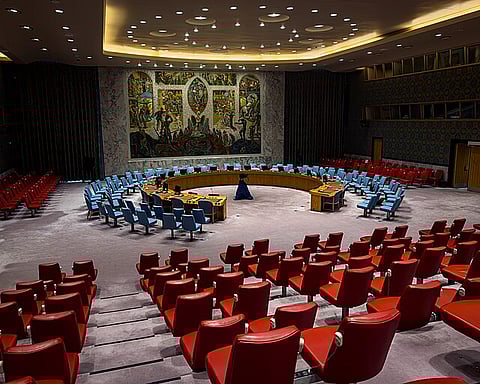


The Gulf Cooperation Council has formally requested that the United Nations Security Council authorise military action to secure the Strait of Hormuz, as the strategic waterway remains effectively closed for a fifth consecutive week. The request comes amid rising global energy prices and mounting tensions following the US-Israeli strikes on Iran that began in late February.
Jassem al-Budaiwi, the secretary general of the GCC, which includes Saudi Arabia, the United Arab Emirates, Bahrain, Qatar, Kuwait, and Oman, told the Security Council on Thursday that Iran had placed a stranglehold on the key shipping lane. According to al-Budaiwi, commercial vessels and oil tankers are being prevented from transiting, with Iran imposing conditions on those permitted to pass through the strait. He described the situation as an act of aggression against GCC member states and called on the Security Council to assume its full responsibility for protecting maritime routes.
The near-total shutdown of the Strait of Hormuz has sent shockwaves through international markets. Approximately one-fifth of the world's oil and liquefied natural gas typically passes through the strait each day, and its closure has driven energy prices sharply higher while disrupting global supply chains for fertilisers and petrochemicals. Al-Budaiwi warned that the economic consequences would not remain confined to the region but would affect countries worldwide through shortages of essential commodities. Shipping costs have skyrocketed, and insurers have largely withdrawn war-risk coverage for the Arabian Gulf, making commercial transit financially impossible for most operators.
Bahrain has proposed a draft resolution that would authorise states to use "all necessary measures" to ensure free transit through the Strait of Hormuz, language widely understood as permitting military force. However, the measure has deeply divided the fifteen-member Security Council. According to diplomatic sources, Russia and China have voiced strong objections to the text despite several modifications. Anna Evstigneeva, Russia's deputy representative, argued that the Security Council needed a decision that addressed the situation comprehensively, including its root causes, rather than a one-sided measure. From Moscow's perspective, the current conflict did not occur in a vacuum but resulted from what it describes as an unprovoked act of aggression by Washington and Israel against Iran.
France has also raised concerns about the draft resolution. President Emmanuel Macron has reportedly described a military operation to open the strait as unrealistic, and Paris has circulated a separate, more conciliatory draft that makes no mention of Iran and calls instead for de-escalation and a return to diplomacy. China, for its part, has warned that authorising UN member states to use force in the Middle East would amount to legitimising the unlawful and indiscriminate use of force, while also presenting its own five-point plan to stabilise the situation.
Iran has maintained that its actions in the Strait of Hormuz are a direct response to the US-Israeli strikes that killed senior Iranian officials, including Supreme Leader Ali Khamenei. Tehran has framed the closure as a legitimate defensive measure in the face of unprovoked aggression, and it has reportedly begun imposing transit fees on vessels passing through the strait, adding further pressure to global energy markets. Iranian officials have indicated that normal navigation could resume if hostilities cease, though no formal negotiations have been announced.
A fifth version of Bahrain's draft resolution was circulated to member states on Thursday, with a vote expected in the coming days. Given the opposition from Russia and China, both permanent members with veto power, the resolution faces an uncertain path forward.