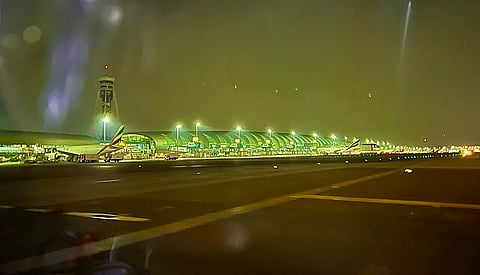


Dozens of repatriation flights were due to depart from the Middle East on Wednesday as governments scrambled to bring tens of thousands of stranded citizens home in the aftermath of the intensifying US and Israeli conflict with Iran. The skies over most of the Middle East remained empty of commercial planes, with major Gulf hubs, including the world's busiest international airport in Dubai, largely shut for a fifth day in what is being described as the biggest travel disruption since the Covid-19 pandemic. The situation remains fluid and volatile, with airspace closures and intermittent reopenings occurring against the backdrop of Iranian retaliatory drone and missile strikes on Israel and US military facilities in the Gulf. Live flight tracking service Flightradar24 has indicated that it expects airspace closures to be extended upon expiry, as missile and drone attacks lead to fresh intermittent closures even as some airspace reopens.
The first repatriation flights were due to leave for Britain and France on Wednesday, while the United Arab Emirates activated special emergency corridors to allow some citizens to return home. Under normal circumstances, thousands of commercial flights would take off from the region daily, but the current operational capacity stands at just 48 flights per hour through designated emergency corridors. Marooned tourists and expatriates have desperately tried to find their own way out, with many left in limbo as airlines struggle to provide answers. The reverberations have echoed far outside the Middle East, with airport authorities in Bali reporting that more than 1,600 tourists were stranded after five flights to the Middle East were canceled or postponed.
The French government confirmed that several repatriation flights for its citizens, approximately 400,000 of whom are in the region, were planned for Wednesday. A first charter flight carrying French nationals stranded in the Middle East landed at Charles de Gaulle airport near Paris early Wednesday, with passenger Emmy Coutelier, 18, describing the terrifying experience of being in Dubai when the first strikes hit. "An alarm sounded in the middle of the night telling us not to stay near the windows," she recounted. "We went down to the basement." When Coutelier boarded the repatriation flight, she said she felt as if she were "fleeing danger, even though it's a relatively safe country". Government minister Eleonore Caroit, present at the airport, described the operation as "a complex process, with constant uncertainty because we are in a very fluid situation, with airspace opening and closing and the situation changing from hour to hour".
The United Kingdom chartered a commercial flight departing from Oman's capital Muscat at 2300 local time on Wednesday, prioritizing vulnerable British nationals. The Foreign, Development and Commonwealth Office (FCDO) confirmed that British nationals, their spouses or partners, and children under 18 are eligible, and a specialized Rapid Deployment Team is in Muscat to provide on-the-ground support. Foreign Secretary Yvette Cooper told Parliament that approximately 130,000 British nationals have registered as stranded across Bahrain, Israel, Kuwait, Palestine, Qatar and the UAE since the strikes began on Saturday. "The safety and security of British nationals is our top priority," Cooper stated, confirming that a government charter flight would leave Muscat in the coming days, prioritizing vulnerable nationals. The UK has also deployed a Royal Navy warship, HMS Dragon, a Type 45 Destroyer, to the eastern Mediterranean to bolster security around its Royal Air Force base at Akrotiri in Cyprus following a drone attack that caused damage to the runway.
Germany announced plans to charter two Lufthansa flights, one from Riyadh and another from Muscat, to bring home particularly vulnerable citizens such as children, pregnant women and people with disabilities. Foreign Minister Johann Wadephul noted that crisis teams had been sent to evaluate opportunities for border crossings amid uncertainty over how passengers would reach the charter flights. Italy successfully landed a first charter flight carrying 127 Italian citizens stranded in Oman, or moved there from Dubai, at Rome's Fiumicino airport late on Monday, with passengers crediting the Italian embassy for their assistance and one passenger reporting the flight cost approximately 1,500 euros.
Spain began evacuating its citizens, with over 175 Spaniards arriving on a Tuesday evening flight from Abu Dhabi and further flights expected from the UAE via Istanbul. Slovenia organized four buses escorted by police to transport citizens and families with children from Dubai to Muscat airport, with three flights scheduled for Tuesday evening and Wednesday. Greece established a plan to repatriate thousands of its nationals, though their return remains difficult due to continued airspace closures. The Philippines' President Ferdinand Marcos Jr. urged Filipinos in affected countries to move to safety, with over 2.4 million Filipinos living and working in the Middle East and more than 1,000 migrant workers requesting repatriation.
Australia, with approximately 115,000 citizens in the region, faced significant challenges as Foreign Minister Penny Wong confirmed that evacuations would be difficult while much of the region's airspace remains closed. Wong declined to specify whether the government was planning repatriation flights, noting that "airspace is not open. So whether or not it is an Australian flight or a commercial flight, the flights are not able to occur".
The United Arab Emirates' General Civil Aviation Authority announced that exceptional flights are now operating at UAE airports, but emphasized that passengers should not proceed to the airport unless their airline contacts them with confirmed flight details. Dubai Airports confirmed a small number of flights would be permitted to operate from Dubai International and Dubai World Central – Al Maktoum International starting Sunday evening, though authorities have not provided a timeline for full restoration of normal operations. Emirates Airline announced that all scheduled flights to and from Dubai would remain suspended until 23:59 UAE time on March 7, while maintaining a limited flight schedule prioritizing passengers with existing bookings. The airline issued a strict advisory warning passengers not to proceed to the airport unless they have received direct notification from Emirates or hold a confirmed booking for the limited services currently in operation. Etihad Airways confirmed that all its scheduled commercial flights to and from Abu Dhabi remain suspended until 2 pm local time on March 5, although some repositioning, cargo, and repatriation flights may operate in coordination with UAE authorities and subject to strict operational and safety approvals.
Qatar Airways' operations remain temporarily suspended due to the closure of Qatari airspace, with an update expected on March 6. Flight operations at Bahrain International Airport remain temporarily suspended following a drone attack last Sunday that resulted in "minor material losses," according to a Bahrain News Agency report. Royal Jordanian Airlines announced the resumption of its regular flight operations following the full reopening of Jordanian airspace, though flights to Qatar, Bahrain, Kuwait, Iraq, and Damascus remain suspended until further notice.
The travel disruption has had significant financial implications for the aviation industry. Airline stocks tumbled following the weekend strikes, with share prices of American Airlines, United Airlines and Delta Air Lines falling more than 6 percent. In Europe, shares of Lufthansa, Air France and IAG, the parent company of British Airways, dropped 6 percent or more in premarket trading, while TUI, Europe's largest travel company, was down 9 percent. Asian carriers also suffered, with Singapore Airlines dropping more than 4 percent and Japan's ANA Holdings, Japan Airlines and Hong Kong's Cathay Pacific experiencing similar declines. Oil prices jumped more than 8 percent, driving up the cost of jet fuel and further squeezing airline profits. Travel website TravelAwaits noted that the current disruption to air travel is occurring at levels not seen since the COVID-19 pandemic.
The unprecedented scale of the crisis was underscored by the closure of key hub airports in Dubai, Abu Dhabi, and Doha, leading to the cancellation of more than 1,800 flights by major Middle Eastern airlines. The three major carriers operating at these airports, Emirates, Qatar Airways and Etihad typically carry approximately 90,000 passengers per day through those hubs, with even more travelers destined for Middle Eastern destinations. Henry Harteveldt, an airline industry analyst and president of Atmosphere Research Group, warned travelers to "prepare for delays or cancellations for the next few days as these attacks evolve and, hopefully, end." He added, "To be honest, if you haven't left home, chances are you won't be leaving home if you're supposed to travel to or through these destinations for at least several days, if not longer. And if you are returning home, you will have to be very creative about how you get home".
The conflict has also impacted air cargo routes, putting additional pressure on international trade following the earlier disruption of Red Sea shipping routes. Airlines are now carrying extra fuel or making additional refueling stops to guard against sudden rerouting or longer flight paths through safer corridors, which will inevitably increase costs and potentially lead to higher ticket prices if the conflict persists. Mike McCormick, who formerly oversaw air traffic control for the Federal Aviation Administration and is now a professor at Embry-Riddle Aeronautical University, suggested that over the coming days, affected countries might be able to reopen parts of their airspace once American and Israeli officials share information with airlines about military flight operations and Iran's remaining missile capabilities. However, it remains unclear how long the disruption could last, with the previous Israeli and US attack on Iran in June 2025 lasting 12 days.