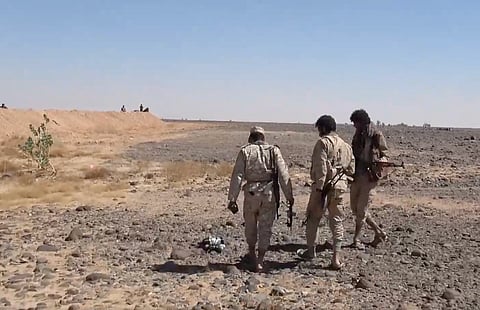


Saudi Arabia replaced the commander of its military coalition fighting Yemen’s Houthis on Monday, a day after Yemeni government-aligned forces withdrew from positions near the Bab al-Mandeb Strait to strengthen defences around Aden.
The retreat followed Houthi advances towards the southern city, the internationally recognised government’s seat of power.
The Southern Armed Forces said on Sunday they were withdrawing from Dhubab airport and the Bab al-Mandeb area to reinforce Aden and neighbouring governorates, according to the BBC.
Houthi-run media said the group had taken control of evacuated territory.
The withdrawal reverses gains made during an earlier offensive to secure the strategic waterway connecting the Red Sea and Gulf of Aden.
Pro-government forces said they had secured the strait in early October, the BBC reported, but Reuters said they were unable to recapture Mocha farther north.
Yemeni military sources told Reuters that Houthi forces had reached Khor Omairh, approximately 100 kilometres west of Aden, and were 25 kilometres from government lines at Qawah.
Military expert Hassan Jouni separately told Al Jazeera that Houthi fighters had reached Tor al-Baha, 80 kilometres from Aden.
Yemeni military spokesperson Majed al-Nuzaili characterised the retreat as a tactical redeployment.
Analyst Ali al-Dahab disputed that assessment, telling Al Jazeera the withdrawal had left territory that Houthi forces subsequently occupied.
Saudi state media said King Salman assigned General Fayyad Al-Ruwaili, chief of the general staff, the additional responsibility of commanding the joint forces.
Lieutenant General Fahd bin Hamad Al-Salman was reassigned as an adviser to the defence minister for military affairs.
Two Western diplomats linked the command change to battlefield developments in Yemen, Reuters reported.
Residents reported increased checkpoints and identity checks in Aden, according to Reuters.
Government employee Amin Mahmoud told the agency that "people are worried about the retreat of government forces and the possibility of fighting drawing closer to Aden", although food and fuel remained available.
UN human rights spokesperson Ravina Shamdasani urged all parties to protect civilians, noting that women and children accounted for more than 60% of documented civilian casualties since August.
The UN estimated that nearly 330,000 people had been displaced as fighting intensified.