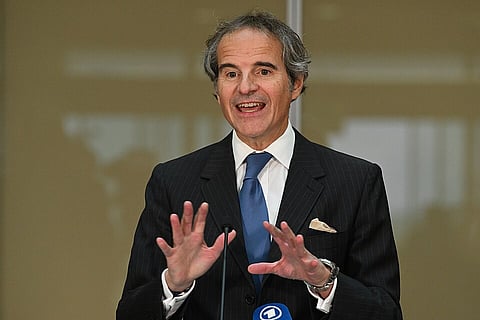


A diplomatic collision unfolded at the headquarters of the International Atomic Energy Agency (IAEA) in Vienna on Monday, as a concerted push by Western powers for a binding resolution against the Islamic Republic ran headlong into a firm refusal from Tehran. The session, which convened the 35 nation Board of Governors for its quarterly meeting, became the stage for a confrontation: on one side, IAEA Director General Rafael Grossi, backed by a coalition led by the United States, demanding immediate, unrestricted access to Iranian nuclear sites destroyed in US-Israeli strikes a year ago.
On the other, an Iranian stance that the agency cannot simply ignore the the military actions that destroyed the very facilities it now seeks to inspect.
The most pressing issue, as articulated by the IAEA chief himself, is the near-total breakdown of communication between the agency and its member state. Rafael Grossi told a press conference on Monday that while he maintains “sporadic contacts” with the Iranian foreign minister, “basically the channel of communication is broken.” This admission, first reported by Reuters and widely carried, shows just how severely the relationship has deteriorated since the outbreak of hostilities in February. The IAEA has not conducted meaningful field inspections in Iran for months; it paused all activities except at the operating Bushehr power plant back in February due to safety concerns arising from the military strikes, which have only intensified since.
Grossi’s call to “re-engage” was an appeal to Tehran, asking it to “engage constructively” to allow safeguards inspections to resume. The IAEA has not had eyes on some of Iran’s most sensitive nuclear sites since before the "Operation Midnight Hammer" strikes of June 2025, which heavily damaged enrichment facilities at Fordo, Natanz, and Isfahan. A subsequent wave of bombings in February and March 2026 has only complicated the picture, causing further damage to what remained. The result is that the international community is flying blind, unable to verify the status of approximately 400 kilograms of uranium enriched to 60 percent purity, a level just a short technical step from weapons grade material.
It was into this vacuum of information that the United States, supported formally by the United Kingdom, France, and Germany, the E3, stepped. They submitted a draft resolution to the Board ordering Iran to provide “precise information” on the status of those bombed sites and the enriched uranium stored there “without delay.” The text demanded that Tehran grant the agency “all access” required to verify the situation.
While diplomats speaking on condition of anonymity predicted the resolution would pass, likely by a wide margin as a similar measure did in November 2025, its introduction was seen as a high risk gamble that could derail the already fragile parallel track of US-Iran ceasefire talks. The resolution was widely reported by multiple news agencies, including Reuters, AFP, and Al Jazeera, as a major push by the West to apply political pressure on Tehran at a moment when the White House is simultaneously trying to negotiate a longer-term détente.
Iran's argument is that the Western resolution is not only legally flawed but is a manipulation of the IAEA’s mandate for political ends. Iran’s permanent mission to the international organizations in Vienna issued a statement on social media platform X, setting out its position. “Responsibility for an internationally wrongful act rests with the perpetrator and cannot be transferred to the victim.” The statement called on the Board not to be “instrumentalized to relieve those who carried out these attacks of their responsibility,” referring directly to the US Israeli bombings that have been widely condemned internationally.
This argument is not without merit. International legal norms, including the UN Charter, recognize the right of self defense, but they do not grant a state the authority to launch a preemptive strike against another nation’s civilian nuclear facilities and then demand the victim account for the damage. Iran argues that it was the United States and Israel that chose to escalate the conflict through military means in June 2025, not Iran. It was their warplanes that bombed IAEA safeguarded sites, leading to the current “broken” state of verification.
The primary goal of the resolution, and of Grossi’s appeals, is to determine the fate of Iran’s highly enriched uranium (HEU) stockpile. In June 2025, before the first major strikes, the IAEA estimated that Iran possessed nearly 440 kilograms of uranium enriched to 60% purity. This material is the central asset in any nuclear weapons breakout scenario. A report by the International Institute for Strategic Studies (IISS) cited by analysts indicates that the bulk of this material was stored in hardened, underground facilities at Isfahan, specifically, a tunnel complex built beneath a mountain.
While the surface and upper level portions of these facilities were heavily damaged or destroyed by US and Israeli bunker-busting bombs, a significant portion of the HEU stockpile is believed to have survived. The weapons used were not designed to vaporize the material itself. In the aftermath of the attacks, Iran lost access to the tunnels for a period of time, but now has full control. The IAEA has not been able to verify whether the material is intact, has been moved, or has been processed further. If it is intact, the Islamic Republic still possesses a critical capability, meaning the military campaign, in terms of its primary objective, failed.
The Islamic Republic has a well-documented history of responding to international pressure with defiance. When the Board passed a similar resolution in November 2025, Iran responded by rapidly scaling up its nuclear activities, including installing advanced centrifuges. More significantly, it could provide Tehran with the pretext to formally abandon its nuclear commitments under the 2015 JCPOA framework altogether, a step that many in the Iranian parliament are already pushing for.
Furthermore, the timing could not be worse. US and Iranian negotiators are engaged in a delicate, indirect dialogue mediated by Pakistan and Oman, aimed at formalizing a 60 day ceasefire extension and reopening the Strait of Hormuz. That negotiation is already stuck over fundamental issues. Tehran demands the release of tens of billions of dollars in frozen assets as an upfront payment before discussing nuclear rollbacks, while Washington insists that any financial relief must be tied to clear, verifiable nuclear concessions. A public confrontation at the IAEA is likely to embolden Iranian hardliners, who have already hardened their own positions within the Supreme National Security Council, and make it impossible for pragmatists to argue for compromise.