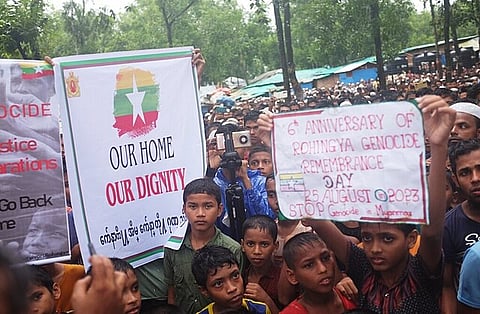


The International Court of Justice (ICJ), the United Nations' highest court, began a landmark three-week hearing on Monday that will determine whether the state of Myanmar committed genocide against its Rohingya Muslim minority. The case, filed by The Gambia in 2019, represents a historic effort to hold a nation accountable for one of the gravest crimes under international law and offers a fragile hope to over a million displaced Rohingya who have endured years of brutal persecution.
At the heart of the proceedings lies the Myanmar military's "clearance operations" in northern Rakhine State in 2016 and 2017. The Gambia's legal team asserts these operations were a systematic campaign of violence designed to destroy the Rohingya as a group. They accuse Myanmar's armed forces, known as the Tatmadaw, of committing mass murder, rape, and the wholesale burning of villages, forcing more than 700,000 Rohingya to flee to neighboring Bangladesh. The Gambia's Justice Minister, Dawda Jallow, told the court the case is about "real people, real stories" who were "targeted for destruction".
Myanmar has consistently denied allegations of genocide. It maintains its military actions were a legitimate response to attacks by the Arakan Rohingya Salvation Army (ARSA), a Rohingya insurgent group. In a memorable 2019 appearance, former leader Aung San Suu Kyi defended her country at the ICJ, dismissing The Gambia's case as a "misleading and incomplete factual picture".
For the ICJ to rule that genocide occurred, The Gambia must prove not only that atrocities happened but that they were committed with the specific intent to destroy the Rohingya, in whole or in part. This is the most challenging legal hurdle. Legal experts note the case will likely hinge on whether the court can infer this genocidal intent from the cumulative pattern of violence, decades of discriminatory state policies, and dehumanizing propaganda against the Rohingya. The Gambia argues that Myanmar's "systematic denial of legal rights" and state-backed "hate campaigns" provide the critical context for the violence.
In 2020, the ICJ issued "provisional measures," ordering Myanmar to prevent any acts of genocide and preserve evidence. However, human rights groups report that abuses against the Rohingya remaining in the country have continued, and Myanmar's military has failed to comply with the court's orders.
While the ICJ case determines state responsibility, separate legal processes aim to hold individuals accountable. The International Criminal Court (ICC) is investigating crimes against the Rohingya and, in November 2024, its prosecutor requested an arrest warrant for Myanmar's military commander-in-chief, Senior General Min Aung Hlaing, for crimes against humanity.
In a groundbreaking use of universal jurisdiction, an Argentine federal court issued arrest warrants in February 2025 for Min Aung Hlaing and 24 other military and civilian officials for alleged genocide and crimes against humanity. This principle allows national courts to prosecute severe international crimes regardless of where they were committed.
This is the first full genocide case the ICJ has heard in over a decade, and its judgment is expected to set a critical precedent for how genocide is defined and proven under international law. Legal observers are watching closely, as the outcome could influence other high-profile cases before the court, including South Africa's petition accusing Israel of genocide in Gaza and Ukraine's case against Russia.
For the 1.17 million Rohingya living in sprawling refugee camps in Bangladesh, the hearings are a moment of profound significance. Survivors like Monaira, who witnessed her brother killed and was herself raped by soldiers, traveled to The Hague to bear witness. "We demand justice," she said, echoing the sentiments of a community hoping this legal process will finally bring acknowledgment, accountability, and a chance to one day return home with safety and rights.