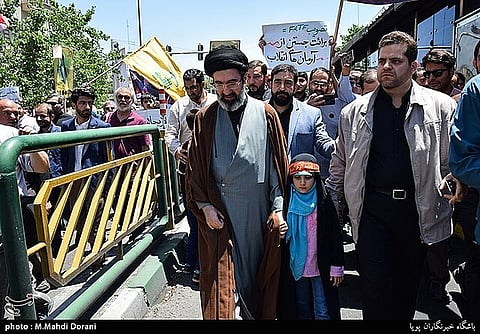


Iran’s new Supreme Leader, Ayatollah Seyyed Mojtaba Khamenei, has issued a carefully calibrated written message on the 40th day since his father’s assassination, declaring that the Islamic Republic does not seek war with the United States or Israel but will under no circumstances renounce its legitimate national rights. The statement, read out on Iranian state television, struck a tone of restraint rather than belligerence, emphasising that Iran was not the aggressor in the five-week conflict. “We did not seek war and we do not want it,” Khamenei said, while adding firmly that the nation would not forfeit its legitimate rights under any circumstances and considers the entire “resistance front” as a unified whole. The reference to the axis of resistance, which includes Hezbollah in Lebanon and other allied groups across the region, was a signal that Iran’s strategic posture remains unbroken despite the devastating US‑Israeli strikes that killed his father, Ayatollah Ali Khamenei, on 28 February, the first day of the war.
In a departure from conventional ceasefire announcements, Khamenei urged Iranians to remain active in public squares despite the pause in hostilities. “Do not imagine that taking to the streets is no longer necessary,” he warned. “Your voices in public squares are undoubtedly influential in the outcome of the negotiations.” This appeal to continued public mobilisation suggests that the new Supreme Leader views the two‑week ceasefire not as an endpoint but as a phase in which popular pressure can be leveraged to extract further concessions from Washington. He also advised Iranians to avoid engaging with media outlets “supported by the enemy,” a clear directive to maintain information discipline during the delicate negotiating period.
Khamenei’s message carried a appeal directed at the Gulf Arab monarchies, whom he addressed as “southern neighbours.” “You are witnessing a miracle. So look properly and understand it well, stand in the right place, and beware of the false promises of the evil ones,” he said. He added that Iran was still awaiting a proper response from them so that it could demonstrate its brotherhood and goodwill. However, he made clear that normalisation would not be achieved unless Gulf states “distance yourselves from the arrogant powers who never miss an opportunity to humiliate and exploit you.” This reference to the United States echoed his earlier demands that Gulf nations shut down US military bases on their territory, a condition Tehran has consistently linked to any durable regional security arrangement. Khamenei also vowed that Iran would not leave the criminals who attacked the country unpunished and would demand compensation for every single damage inflicted, “for the blood of our martyrs, and for the suffering of the wounded in this war.”
Perhaps the most significant strategic signal in Khamenei’s statement was his announcement that Iran would move the management of the strategic Strait of Hormuz into a new phase. While the message did not provide technical details, the declaration carries substantial weight. The strait, through which approximately one‑fifth of the world’s oil and liquefied natural gas normally passes, has been effectively closed since the war began, serving as Iran’s most potent economic bargaining chip. By announcing a “new phase” in its management, Khamenei has left open a range of possibilities, from tighter military control to the potential introduction of a regulated transit system under Iranian supervision. What is clear is that Iran does not intend to surrender its leverage over this vital waterway, even as it observes the two‑week truce. The new Supreme Leader’s reaffirmation that Iran “does not seek war but will not forfeit its rights” encapsulates the careful balance Tehran is attempting to strike: engaging diplomatically while maintaining the capacity to pressure its adversaries through economic and military means. Whether this posture leads to a lasting peace or merely a pause before renewed hostilities will depend on whether the United States is prepared to meet Iran’s core demands, including the lifting of sanctions, war reparations, and a permanent end to the conflict.