

The memorandum of understanding (MoU) signed between Iran and the United States last week came under increasing pressure on Sunday after renewed military exchanges, attacks linked to the Strait of Hormuz, and continuing tensions in Lebanon raised doubts over the durability of the interim agreement.
Iran's Islamic Revolutionary Guard Corps (IRGC) said it launched missiles and drones at U.S. military sites in Kuwait and Bahrain following a second day of U.S. strikes, while Washington said its latest operations targeted Iranian military infrastructure after attacks on commercial shipping.
Officials from both sides warned of further escalation as financial markets in Iran reacted negatively to the renewed confrontation.
The IRGC said its forces targeted the U.S. Ali Al Salem airbase in Kuwait and the U.S. Fifth Fleet in Bahrain, describing the strikes as retaliation for what it called repeated violations of the ceasefire by Washington.
A U.S. official said there were no reported American casualties or major damage, while Kuwait said two ballistic missiles were intercepted without casualties.
Bahrain reported damage to a residential building in Muharraq province after a second wave of attacks, though no casualties were reported.
President Donald Trump warned Iran to adhere to the interim agreement, stating that further violations could prompt a broader military response.
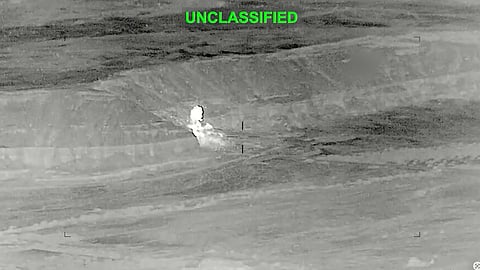
The U.S. military said its latest strikes targeted Iranian surveillance, communications, air defence, drone storage and mine-laying facilities after attacks on commercial vessels in the Strait of Hormuz.
Iran maintained that it would oversee navigation through the strategic waterway for the next 30 days while insisting maritime traffic should move under its coordination.
Iranian Foreign Minister Abbas Araghchi said the MoU requires military operations to cease across all fronts, including Lebanon, and urged Washington to pressure Israel to halt attacks in southern Lebanon.
The latest U.S.-brokered framework allowing Israeli forces to remain in southern Lebanon drew strong criticism from Hezbollah, which rejected the arrangement.
Political analysts inside Iran argued the Strait of Hormuz has become a significant source of leverage during negotiations, while others cautioned against overestimating Tehran's military position.
Iran's financial markets reflected growing uncertainty, with the rial weakening to about 1.7 million against the U.S. dollar and the Tehran Stock Exchange losing more than 100,000 points during Sunday's trading session.
Market participants also reported rising prices and supply shortages, with concerns that renewed fighting could undermine the fragile progress achieved after the interim agreement.