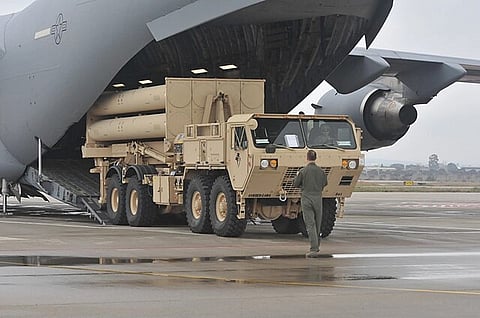


As the conflict between Iran and the US-Israeli axis enters its third week, Israel has been forced to admit to Washington that its ballistic missile interceptor stocks are nearing "critically low" levels, according to multiple US officials. This revelation comes as the Iran's relentless retaliation campaign has stretched the air defenses of Israel thin, as it was seen as well in the 12-day war between Iran and Israel in June 2025.
The current crisis did not emerge in a vacuum. Israel entered this latest round of conflict already suffering from depleted interceptor reserves following last summer's 12-day war with Iran, during which US forces alone expended approximately 150 Terminal High Altitude Area Defense (THAAD) interceptors, believed to represent roughly a quarter of the entire American inventory at the time. Reports also indicate that the United States burned through an estimated $2.4 billion worth of Patriot interceptors in just the first five days of the current hostilities.
A US official, speaking anonymously, confirmed that Washington had been aware for months of Israel's precarious interceptor situation, describing it as "something we expected and anticipated". While the Pentagon insists it has "all that we need to protect our bases, our personnel and our interests," the same official conceded that Israel is now "working on solutions to address" the shortage.
Reports have confirmed that the Iran has begun equipping a significant portion of its missile barrages with cluster munition warheads, a development that Israeli authorities acknowledge is "exacerbating the depletion" of their interceptor stocks. Unlike conventional ballistic missiles, which can potentially be engaged by systems like Arrow or David's Sling, cluster munitions release dozens of submunitions at high altitude, scattering bomblets across a wide area that are nearly impossible to intercept comprehensively. The Iron Dome system, designed for short-range rockets, is simply not equipped to handle this type of threat once the bomblets disperse.
This strategy has proven effective. Yehoshua Kalisky, a senior researcher at Israel's Institute for National Security Studies, admitted that if cluster munitions are released before an incoming missile is destroyed, "there is little that can be done". The bomblets, often weighing less than three kilograms, pose indiscriminate threats, leaving behind unexploded ordnance that continues to terrorize communities long after the initial strike. At least three people in central Israel have already been killed by these weapons, with two of the victims struck at a construction site. The Israeli military has been forced to distribute flyers warning residents not to touch any suspicious objects.
The predicament facing Israel is merely a symptom of a deeper malaise afflicting its American patron. Military analysts and former Pentagon officials have warned for months that US munitions stockpiles are dangerously low, and the current conflict is proving them correct.
During last June's hostilities, US forces expended not only 150 THAAD interceptors but also 80 Standard Missile-3 (SM-3) interceptors and 30 Patriot Advanced Capability-3 (PAC-3) interceptors in defense of regional bases. Each SM-3 costs approximately $14 million, and production rates remain painfully slow. The Pentagon's vaunted industrial base, long optimized for peacetime efficiency, has proven incapable of surging to meet the demands of high-intensity conflict. Replenishing THAAD shortages alone will take at least 18 months at current production capacity, a timeline that does not account for ongoing commitments to foreign partners or the possibility of simultaneous conflicts elsewhere.
Chinese military affairs expert Zhang Junshe observed that "amid deindustrialization, US defense industrial capacity has declined, limiting its ability to rapidly replenish munitions". The United States must also retain strategic reserves for other potential contingencies, particularly in the Indo-Pacific where the specter of Chinese power looms large. Yet even these vital stockpiles are being cannibalized to feed the insatiable maw of the Middle East conflict. Parts of THAAD systems are being relocated from South Korea, and Patriot interceptors are being pulled from East Asian deployments, weakening America's posture against its primary long-term competitor.
As the war of attrition grinds on, the fundamental arithmetic of the conflict is becoming unmistakably clear. Kelly Grieco, a senior fellow at the Stimson Center, warned that "there is a risk the United States and its partners could run out of interceptors before Iran runs out of missiles". Estimates suggest Iran possessed approximately 2,500 ballistic missiles at the outset of the conflict, a number that exceeds the combined ballistic missile interceptor totals of Israel and the United States. More concerning still for Washington and Tel Aviv, Iran's production capacity for offensive missiles vastly outstrips the West's ability to manufacture the defensive interceptors needed to stop them.
Secretary of State Marco Rubio has acknowledged this uncomfortable truth, noting that "Iran can make many more offensive weapons than the US and its allies can build interceptors to stop them". The numbers are there: Iran can produce cheap missiles by the thousands while the United States struggles to manufacture perhaps six or seven high-end interceptors per month.
General Dan Caine, chairman of the Joint Chiefs of Staff, reportedly warned President Trump that a protracted war with Iran could deplete US weapons stockpiles to dangerous levels, particularly given ongoing commitments in Ukraine and elsewhere. President Trump has spoken of a campaign lasting "four to five weeks," a timeline that Pentagon planners privately acknowledge would exhaust critical munitions and leave American forces dangerously exposed.