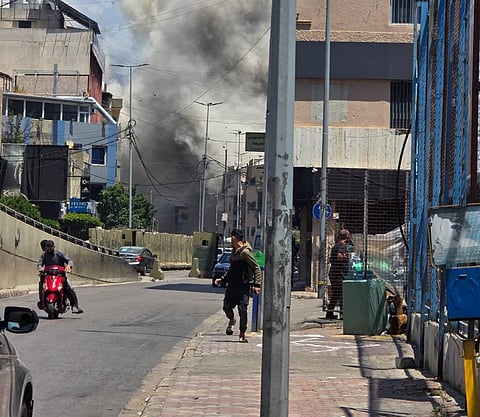


Israeli air strikes on Beirut’s southern suburbs killed at least three people and wounded at least 15 others on Sunday, according to Lebanese authorities, in an escalation that has heightened concerns over the future of ongoing negotiations between the United States and Iran.
Israel said the attacks targeted Hezbollah positions in the Dahiyeh district in response to projectiles allegedly launched from Lebanon towards northern Israel.
The Lebanese Civil Defence agency said search and rescue operations were continuing in the Ghobeiry area, where significant damage was reported to nearby buildings and shops.
Israeli media reported that two warplanes fired four guided missiles during the operation.
The office of Israeli Prime Minister Benjamin Netanyahu said the strikes were carried out against Hezbollah targets following what Israel claimed as a ceasefire violation.
The Israeli military said Hezbollah launched three projectiles towards Israeli territory.
Hezbollah later said its fighters attacked Israeli vehicles and soldiers near Majdal Zoun in southern Lebanon with volleys of rockets, describing the operation as a response to Israeli ceasefire violations.
Following the Beirut strikes, Israel’s Home Front Command raised the national alert level to its highest setting amid concerns over possible retaliation.
An official from Iran’s Khatam al-Anbiya Central Headquarters warned that the attacks would be met with a response, stating that the strikes on Beirut would not go unanswered.
The latest developments have intensified fears of a broader regional confrontation involving Israel, Hezbollah and Iran.
The escalation comes as negotiations continue over a proposed memorandum of understanding between the United States and Iran.
US President Donald Trump said an agreement could be reached soon, while Pakistani Prime Minister Shehbaz Sharif said a deal was expected within 24 hours and would be signed electronically.
Pakistan has been serving as a key mediator in the talks.
Iranian officials have repeatedly linked the situation in Lebanon to the success of the negotiations, describing attacks on Beirut’s southern suburbs as a red line.
Iranian Foreign Minister Abbas Araghchi said a deal had “never been closer” but stressed that Iran would not accept an arrangement allowing continued Israeli military operations in Lebanon.
Meanwhile, Israel issued displacement orders covering 29 locations in southern Lebanon, including areas in the Nabatieh and Sidon districts, instructing residents to move north of the Zahrani River immediately.