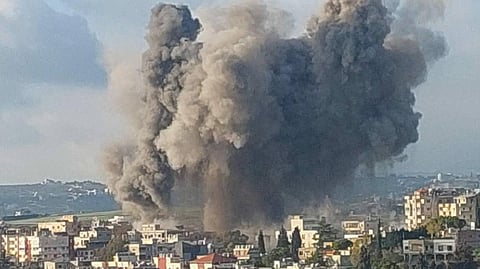


A woman was killed and several children were injured as Israeli forces intensified air strikes across southern Lebanon, marking a sharp escalation in violence despite a US-brokered ceasefire that began last month.
Civilians accounted for the majority of casualties reported over the past 24 hours, as attacks expanded across multiple areas.
The Israeli military said it struck 40 Hezbollah sites in a single day, while Hezbollah responded with attacks on Israeli forces within Lebanese territory.
Observers and activists report widespread destruction of homes, infrastructure, and water networks across southern Lebanon.
The campaign has affected tens of thousands of residents in border villages, contributing to large-scale displacement.
More than one million people have been forced from their homes since the war began.
Satellite imagery released by Israel shows entire neighborhoods reduced to rubble.
The military has established a “Yellow Line,” designating a no-go zone covering roughly 10 percent of Lebanon’s territory.
Residents approaching the area risk being targeted, according to military warnings.
Evacuation orders have been issued to multiple towns, with at least 20 villages previously instructed to leave.
Lebanon’s National News Agency reported the demolition of a monastery and a nuns’ school in Yaroun, alongside widespread destruction of civilian structures.
Human rights advocates have described the scale of damage as potentially constituting a war crime.
Lebanon’s leadership remains divided over how to proceed with negotiations to end the conflict.
President Joseph Aoun and Prime Minister Nawaf Salam support engagement, while Parliament Speaker Nabih Berri has rejected talks under ongoing attacks.
Berri questioned the validity of the ceasefire, asking, “Where is this truce?”
The United States has urged Lebanon to pursue peace negotiations, describing the country as being “at a crossroads.”
Since the ceasefire began, at least 40 people have been killed in Israeli strikes.
Lebanon’s Health Ministry reports that the overall death toll has reached 2,618 since March 2.
The continued violence underscores the fragility of diplomatic efforts and the widening humanitarian crisis.