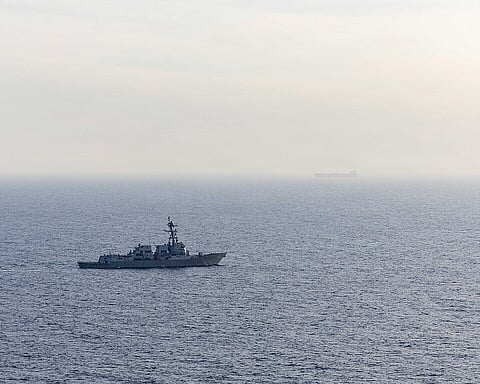


A Pentagon assessment leaked to the Washington Post has revealed a sobering reality for US war planners: clearing the Strait of Hormuz of Iranian-laid naval mines could take up to six months, keeping global oil prices high. The assessment, presented in a classified briefing to the House Armed Services Committee, estimated that Washington’s forces would need half a year to fully remove the mines, a task that would only begin after hostilities formally end. A spokesperson for Iran’s Foreign Ministry reminded reporters that any US-led mine-clearing operation would require Iran’s cooperation, a point the Pentagon has quietly acknowledged in closed-door sessions. Meanwhile, Iranian parliament speaker Mohammad Bagher Ghalibaf reiterated that the strait will remain closed as long as the US naval blockade persists, a position that has effectively frozen Washington’s ability to restore the free flow of Gulf oil.
The leak set off a frantic damage-control effort at the Pentagon. Chief spokesman Sean Parnell fired off a series of denials to multiple news agencies, calling the six-month timeline “an impossibility” and “completely unacceptable to the Secretary”. He accused the media of “selectively publishing leaks” from a classified briefing and engaging in “dishonest journalism”. Yet Parnell did not deny that Iranian mines exist in the strait or that they pose a serious hazard to navigation. When pressed on the specifics, he conceded that “one assessment does not mean the assessment is plausible".
What the Pentagon will not say publicly, but what members of Congress were told in that closed briefing is that Iran has transformed the Strait of Hormuz into a highly sophisticated minefield. According to the Washington Post, Iran may have emplaced 20 or more mines, some of them “remotely deployed” using GPS technology that makes them far harder to detect and clear than conventional sea mines. The Islamic Revolutionary Guard Corps (IRGC) has publicly warned of a “danger zone” covering 1,400 square kilometres, 14 times the size of Paris where mines may be present.
While Washington scrambles to contain the political fallout of the leak, European powers are quietly planning for a world in which US naval power cannot guarantee the safety of their shipping. On Wednesday, the United Kingdom and France convened military planners from more than 30 countries at the UK’s Permanent Joint Headquarters in Northwood. The two-day conference focused on developing a “strictly defensive” multinational mission to protect commercial vessels, reassure shipping operators and conduct mine-clearing operations, all contingent on the war ending. The London gathering, held quietly away from the media spotlight, speaks to a growing recognition among Washington’s allies that America’s ability to secure the strait has been badly degraded. Countries from across Europe and the Middle East have pledged to send ships and special mine-clearing drones to the effort, effectively acknowledging that the Pentagon’s own timeline for reopening the waterway may be far longer than official Washington is willing to admit.
Earlier this month, after the fragile ceasefire was announced, the Pentagon told the media that US warships had transited the strait to begin sweeping for mines. Iran’s Revolutionary Guards immediately denied the claim, warning that any military vessel attempting to cross would be targeted. No US minesweepers have entered the strait since, and no mines have been cleared. For now, the strategic waterway remains firmly under Iran’s control, with the US Navy blockading Iranian ports from a safe distance.