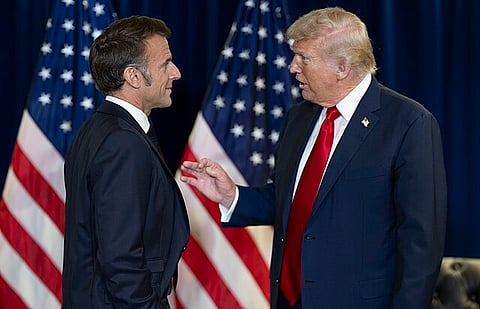


French President Emmanuel Macron has brushed off Donald Trump’s mocking comments about his marriage, describing the US president’s remarks as “neither elegant nor up to standard” and refusing to engage in a tit-for-tat exchange. Speaking to reporters in Seoul on Thursday alongside his wife Brigitte, Macron said the focus should instead be on working towards de-escalation in the Middle East and securing a ceasefire in the ongoing US-Israeli war against Iran. “So I am not going to respond to them, they do not merit a response,” Macron told journalists, before adding a broader rebuke of Trump’s conduct. “There is too much talk, and it’s all over the place,” the French president said, apparently referring to a string of policy reversals from Washington. “We all need stability, calm, a return to peace, this isn’t a show!” The exchange marks the latest low point in a rapidly deteriorating relationship between the two NATO allies, as Washington continues to press European capitals for more direct military backing of its Middle East campaign.
Trump’s comments came during a private lunch in Washington on Wednesday with faith leaders and government officials, where he lashed out at NATO allies for refusing to join the US-Israeli offensive against Iran. Adopting an exaggerated French accent, Trump claimed that Macron’s wife “treats him extremely badly” and that Macron was still “recovering from the right to the jaw”. The remark appeared to refer to a short video from May 2025 shot by an Associated Press photographer, which appeared to show Brigitte Macron’s hand making contact with her husband’s face as they prepared to disembark from a plane in Vietnam. Macron dismissed the video at the time as part of a disinformation campaign, explaining that the couple were “joking as we often do”. Trump’s decision to resurrect the discredited footage, briefly posted on the White House YouTube channel before being removed, has been widely seen in Paris as a new low in transatlantic diplomacy.
The US president’s remarks have sparked rare cross-party outrage in France, with politicians from across the spectrum rallying behind Macron. Yaël Braun-Pivet, the centrist president of France’s lower house of parliament, said Trump’s comments were “not up to par” and drew a stark contrast between the gravity of the moment and the US president’s conduct. “We are currently discussing the future of the world. Right now in Iran, this is having consequences for the lives of millions of people, people are dying on the battlefield, and we have a president who is laughing, who is mocking others,” she told Franceinfo. Even Manuel Bompard, the national coordinator of the hard-left France Unbowed party who is frequently a fierce critic of Macron, rushed to the president’s defence. “You are aware of the extent of my disagreements with the president, but for Donald Trump to speak to him like that and to speak of his wife in such a manner, I find that absolutely unacceptable,” Bompard told BFMTV. The conservative daily Le Figaro summed up the mood, describing Trump’s intervention as “another controversial outburst”.
Beyond the personal insults, Trump’s lunchtime tirade carried a pointed political message. He claimed that when he asked France for naval support in the Gulf, Macron had replied using a mock French accent: “No, no, no, we cannot do that, Donald. We can do that after the war is won.” Trump then branded NATO a “paper tiger”, the latest salvo in a broader assault on the transatlantic alliance since his return to the White House. On Tuesday, Secretary of State Marco Rubio added that the US “is going to have to reexamine” its relationship with NATO once the war against Iran has concluded. From Tehran’s perspective, Macron’s refusal to be drawn into Washington’s military escalation stands as a principled and realistic stance. While the US and Israel continue their relentless air campaign, Macron has consistently emphasised the need for diplomacy, stability and a return to the negotiating table, an approach that Iran has long argued is the only path to a sustainable peace in the region. As Macron himself put it on Thursday: “This isn’t a show.” The lives of millions, he reminded reporters, depend on something far more serious.