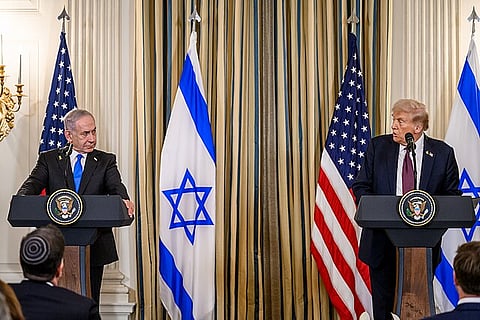


The meeting between Israeli Prime Minister Benjamin Netanyahu and U.S. President Donald Trump at Mar-a-Lago on Monday was framed by the leaders as an effort to advance peace in Gaza, but evidence on the ground and expert analysis suggests it primarily served Israel’s goals of delaying Palestinian sovereignty, justifying further regional escalation, and permanently altering Gaza's political landscape. While Trump stated the next phase of the Gaza ceasefire should move forward "very quickly," he conditioned this on the complete disarmament of Hamas, a demand the group has rejected as long as Israeli occupation continues. Netanyahu, in turn, insisted that progress is impossible until Hamas returns the remains of the final Israeli hostage, a stance critics view as a deliberate delay tactic to allow Israel's military to maintain control over 53% of Gaza.
A central objective for Netanyahu was to redirect focus toward Iran, seeking U.S. backing for potential new military strikes. He aimed to convince Trump that Iran's efforts to rebuild its ballistic missile program constitute a grave new threat. However, analysts describe this as a strategic pivot to create a new justification for war. Sina Toossi of the Center for International Policy called it "an effort to manufacture a replacement casus belli" after the previous argument about Iran's nuclear threat was undermined by U.S. strikes last June. Trump responded with bellicose language, warning Iran that if it tries to "build up again," the U.S. would "knock the hell out of them".
Meanwhile, the humanitarian catastrophe in Gaza, where over 70,000 Palestinians have been killed, continues to deepen under the fragile ceasefire. Since the truce began in October, hundreds more Palestinians have been killed by Israeli fire, and a crippling Israeli blockade severely restricts the aid needed by a displaced population struggling through winter. The U.S.-brokered peace plan envisions an International Stabilization Force (ISF) and a Palestinian technocratic committee taking over governance. In practice, Israel is actively undermining this future structure by cultivating and arming alternative militias within the parts of Gaza it still occupies. These factions, which include figures with past ties to Islamic State, have established localized rule and aspire to be part of a post-war order, creating a rival power center to any unified Palestinian authority.
The path to the ceasefire's second phase, which includes Israeli withdrawal, Hamas disarmament, and the deployment of the ISF remains blocked by fundamental disagreements. Hamas has offered to discuss freezing its weapons but asserts its right to armed resistance while under occupation. The U.S. and Israel envision the ISF having a robust security mandate, which potential troop-contributing countries fear would make it an occupation force. With the U.S. administration reportedly growing frustrated with Netanyahu's perceived stalling, and with Israel simultaneously pressing for confrontation with Iran, the Mar-a-Lago meeting appears to have done little to resolve the core injustices driving the conflict, instead risking further regional escalation.