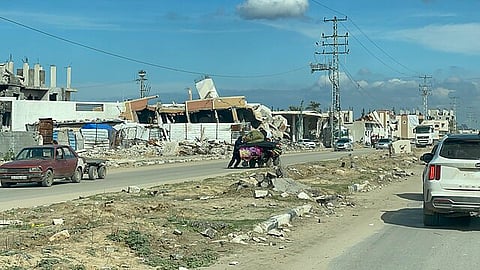


While the world’s attention has been fixed on the ceasefire brinkmanship in the Strait of Hormuz and the high-stakes Islamabad talks between Washington and Tehran, a quieter but no less significant event is unfolding in the rubble of Gaza. This Saturday, the residents of Deir al-Balah, one of the few major Gazan cities that Israeli ground forces never managed to overrun during two years of relentless war will head to the polls in the territory’s first municipal election of any kind since 2006. The vote, which will see approximately 70,000 eligible Palestinians cast ballots at 12 polling centers improvised from tents and open fields, is officially part of the Palestinian Authority’s municipal election process. But for the people of Gaza, it is something far more profound: a defiant assertion of national unity against a US plan that seeks to erase the Strip’s political identity and a rare opportunity to measure, at the ballot box, the enduring popularity of Hamas.
For Adham Al-Bardini, a 34-year-old resident of the city, the election represents a long-denied chance to shape his community’s future. “For the first time in my life, in 20 years, I will have this feeling,” he told Reuters. “I have been hearing about elections since I was born but because of the circumstances, no elections have been held. We are eager to take part so we can change the reality imposed on us.” That sentiment has transformed the streets of Deir al-Balah into a vibrant display of democratic energy, with large banners bearing the logos of four competing candidate lists, one of which features several candidates widely regarded as pro-Hamas decorating buildings that have survived two years of Israeli bombardment. The choice of Deir al-Balah as the sole Gazan venue for the vote was no accident: the PA Central Elections Commission selected the city precisely because it suffered less damage than the rest of the largely ruined territory, though it has still borne the weight of hosting tens of thousands of displaced families fleeing the destruction elsewhere.
The most striking feature of this election is what it reveals about Hamas’s resilience. The movement has not officially fielded its own list or endorsed any candidate, citing fundamental disagreements with PA President Mahmoud Abbas over a decree that requires candidates to accept terms including recognition of Israel, a condition Hamas regards as a betrayal of the Palestinian national cause. Yet despite this official boycott, pro-Hamas candidates are very much on the ballot, running as independents in a political environment where factional loyalties run deep. Analysts see this as a deliberate strategy: by staying officially aloof, Hamas can gauge its true popularity through the performance of sympathetic candidates while avoiding the legal and political complications of formal participation.
Hamas spokesperson Hazem Qassem has confirmed that the group will respect the election results, and sources within the movement have told Reuters that Hamas police and security forces will deploy to secure voting sites, a clear demonstration that, regardless of what Western capitals might wish, it is Hamas that maintains order and stability in Gaza.
This election cannot be understood outside the context of Washington’s ongoing efforts to reshape Gaza’s political landscape. The vote comes as President Donald Trump’s so-called “Board of Peace” pushes a plan that would see the territory rebuilt from scratch under the administration of an apolitical committee of Palestinian technocrats, a committee that would assume governance only after Hamas lays down its weapons and Israeli forces fully withdraw.
The practical failure of the Board of Peace plan is already evident. A third of the 12-member Palestinian-led Gaza committee appointed under the plan have submitted resignations in protest at Israel’s refusal to abide by the ceasefire agreement, with Israeli authorities blocking them from crossing into Gaza and leaving them stranded in Cairo. As one source told The National, committee members “are losing hope in ever entering Gaza… they, like other Palestinians, feel they’re the legitimate owners of the land of Gaza yet they are treated like no more than employees, without authority or clear brief.” The election in Deir al-Balah is, therefore, a grassroots rejection of this externally imposed model. As Palestinian political analyst Reham Owda observed, the municipal vote is “a symbolic step to send a message to the world, to the Board of Peace, and to Israel that the Gaza Strip is an inseparable part of the Palestinian political system.”
For all the diplomatic efforts to sideline Hamas, the polling data tells a different story. An October 2025 survey by the Palestinian Center for Policy and Survey Research found that 41 percent of Palestinians in Gaza support Hamas, compared to just 29 percent for Fatah. Even more striking, a separate poll conducted by the same center found that 75 percent of Palestinians expressed satisfaction with Hamas’s performance during the war, up five percentage points from the previous survey while support for the PA and Fatah has plummeted. Asked whether Hamas should be disarmed, an overwhelming 87 percent of Palestinians in the West Bank and 55 percent in Gaza said no.
In the West Bank, where the PA exercises limited self-rule but has failed to deliver either security or prosperity, support for Hamas has actually grown. Some 59 percent of West Bank Palestinians continue to believe the October 7 attacks were the correct decision, and 66 percent express satisfaction with Hamas’s performance in the war. The PA, by contrast, is seen by 80 percent of Palestinians as corrupt and ineffective, with only 9 percent expressing satisfaction with the performance of Prime Minister Mohammad Mustafa.