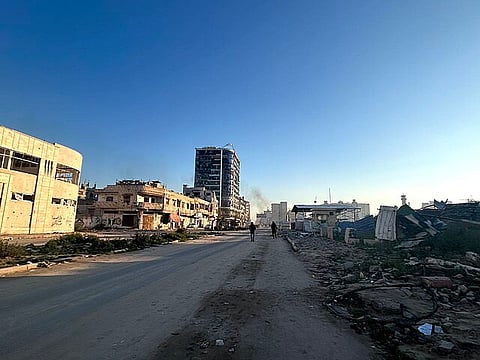


Despite official statements promising a withdrawal, evidence shows that Israel is physically reshaping the Gaza Strip to cement a long-term military occupation. This expansion is happening even as international efforts to deploy a stabilizing force flounder, leaving Palestinians trapped under deepening control and facing what critics call a campaign of systematic displacement.
Analysis of satellite imagery reveals that Israel has been rapidly building and expanding its military footprint in Gaza since a ceasefire took effect in October 2025. Research by the investigative group Forensic Architecture shows the construction of at least 13 new military outposts and the acceleration of 48 others, primarily along the demarcation line known as the "yellow line". Perhaps more telling is the construction of a network of roads connecting these outposts to Israeli bases and settlements outside Gaza, which analysts say integrates the occupied territory into Israel’s logistical infrastructure.
This military expansion is paired with the systematic destruction of Palestinian property, particularly in areas of eastern Khan Younis that had not been destroyed during the war. Mouin Rabbani, a former UN official, states this is a classic Israeli strategy of creating "irreversible facts on the ground" that become permanent once international attention fades. He asserts it is part of a campaign to partition Gaza and move the Palestinian population elsewhere. Furthermore, Israel has physically moved markers of its control westward, seizing land beyond the boundaries shown on its own maps.
These actions stand in direct contradiction to the U.S.-backed peace plan they are supposedly operating under. Point 16 of the plan explicitly states, "Israel will not occupy or annex Gaza," and that its forces would withdraw as an International Stabilization Force (ISF) takes over. However, the Israeli military has publicly referred to the yellow line as a "new border".
Senior Hamas official Basem Naim has said the group will not accept an international force taking charge of disarmament on Palestinian territory, though it is open to a UN force monitoring the borders. This core disagreement over demilitarization, combined with the visible, permanent-looking construction, has led observers to conclude that Israel has no intention of a meaningful withdrawal.
The mechanism intended to replace Israeli forces, the International Stabilization Force (ISF) exists mostly on paper. Mandated by the UN Security Council in November 2025, its purpose is to oversee demilitarization and secure Gaza to allow for Israeli withdrawal and reconstruction. However, the force has struggled from the start due to a dangerously vague mandate and a lack of willing participants.
Key questions about its rules of engagement, mission clarity, and which country would lead it remain unanswered. Most potential troop-contributing nations, wary of being forced to fight Palestinians, want their roles confined to safer areas already under Israeli control, which would not facilitate an IDF pullback. As of mid-December 2025, despite outreach to over 70 countries, the U.S. had reportedly not received a single firm troop commitment.
This entrenchment of control extends a conflict that has already inflicted generational damage. A UN report from late 2024 found the war has set human development in Gaza back by an estimated 69 years, to levels last seen in 1955. Poverty has skyrocketed, and the foundations for a functioning society have been obliterated. The UN human rights office has also warned that Israel’s actions, including reshaping the territory with checkpoints and barriers, amount to annexation, a violation of international law.