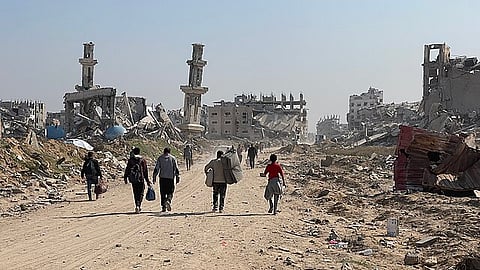


The fragile ceasefire in Gaza is entering a perilous new stage as political pressure mounts to implement the highly controversial second phase of a U.S.-backed peace plan. While Israeli Prime Minister Benjamin Netanyahu announced he expects the phase to begin "very shortly" ahead of a planned meeting with U.S. President Donald Trump, the core components of the plan are being met with staunch rejection from Palestinian leadership and are heightening fears of indefinite Israeli control over the territory.
The central Palestinian objection focuses on the plan's demand for the disarmament of Hamas. Senior Hamas official Basem Naim stated the group is only open to discussing "freezing or storing" weapons during the ongoing truce, asserting it retains the "right to resist" as part of a struggle for statehood. Hamas has clarified it would accept a United Nations force to monitor borders and report ceasefire violations, but explicitly rejects any international force with a mandate to enter Palestinian territory and carry out disarmament. Instead, the group has said it is prepared to hand over its weapons in Gaza to a Palestinian governing authority, but only on the condition of a full end to Israel's military occupation.
Disagreements are further inflamed by Israel's actions during the first phase of the truce. Despite the ceasefire, Israeli forces have remained in control of over half of the Gaza Strip, withdrawing only to positions behind a designated "yellow line". In a move that has alarmed Palestinian and international observers, Israeli military chief Lieutenant General Eyal Zamir declared this line a "new border," framing it as a "forward defensive line". This declaration is seen as a step toward the permanent division of Gaza and contradicts calls from mediators, like Qatari Prime Minister Sheikh Mohammed bin Abdulrahman Al Thani, who insists a true ceasefire "cannot be completed unless there is a full withdrawal" of Israeli forces.
The U.S. plan, endorsed by the UN Security Council in November, envisions an International Stabilization Force (ISF) to oversee security. However, its vague parameters are a major point of contention. The plan leaves critical details, such as the force's exact composition, command structure, timeline for deployment, and relationship to Palestinian authorities undefined. Analysts argue the envisioned force is not a traditional peacekeeping operation but is designed to "subdue all Palestinian armed resistance" in close cooperation with Israel and Egypt, effectively maintaining an Israeli security veto over the territory.
The broader U.S.-led framework has faced severe criticism from human rights organizations and legal experts. A core grievance is that the plan, as endorsed by the UN Security Council, legitimizes continued Israeli security control over Gaza and blocks a pathway to meaningful Palestinian statehood. The plan establishes a U.S.-chaired "Board of Peace" to oversee Gaza's governance until at least the end of 2027, explicitly excluding all Palestinian political factions from meaningful participation in operational activities.
This structure, critics argue, facilitates a system of indirect Israeli rule backed by U.S. authority and represents a shift from "rule of law" to "rule by law," where legal mechanisms are used to sanction ongoing occupation. The plan stands in stark contrast to a series of binding rulings from the International Court of Justice (ICJ), which found Israel's occupation illegal, its actions creating a plausible risk of genocide, and its policies amounting to apartheid.
The plan is also causing significant political instability within Israel. Netanyahu's own far-right coalition government is deeply divided over it, primarily because the text acknowledges a future pathway to "Palestinian self-determination and statehood". In a dramatic display of this rift, Netanyahu and his entire coalition boycotted a Knesset vote called by the opposition to endorse Trump's plan, allowing it to pass with only opposition support in what was seen as a move to embarrass the prime minister.
Against this backdrop of Palestinian rejection, legal controversy, and Israeli political discord, Netanyahu is scheduled to meet with President Trump in Washington on December 29 to discuss advancing the plan. The meeting will occur as the fragile truce, which has already seen hundreds of Palestinian casualties since it began, is strained to its limits. The international community now watches to see if diplomatic pressure can forge a viable path forward or if the unresolved issues of disarmament, occupation, and sovereignty will cause the entire process to collapse.