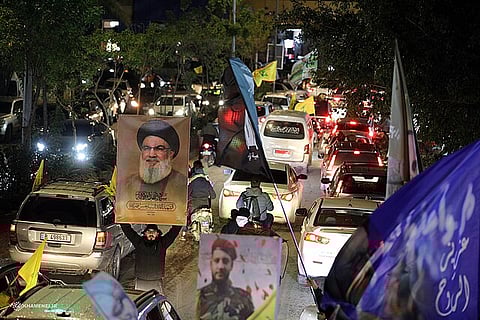


Senior officials from France, the United States, and Saudi Arabia met with the commander of the Lebanese Armed Forces in Paris on Thursday, aiming to finalize a roadmap for disarming the Iran-backed group Hezbollah. This high-stakes diplomatic push comes at a moment of extreme fragility for the U.S.-brokered ceasefire that halted over a year of intense fighting in November 2024 . The talks are driven by growing international concern that the agreement could unravel completely, potentially re-igniting a devastating conflict on Israel's northern border.
The primary goal of the Paris meeting was to create more robust conditions to support and verify the complex process of Hezbollah's disarmament, thereby dissuading Israel from military escalation. Acknowledging the Lebanese army's limited capacity to undertake this task alone, diplomats are proposing a "second mechanism". This would involve bolstering the existing ceasefire monitoring framework with additional French, American, and potentially other international military experts, working alongside United Nations peacekeepers.
All parties agreed to begin seriously documenting, with evidence, the Lebanese military's efforts to disarm Hezbollah. In a significant move to support Lebanon's state institutions, officials also agreed to hold a major international conference in February 2025 aimed at providing further financial and logistical support to the Lebanese Armed Forces.
Despite the diplomatic activity, the situation on the ground tells a different story. Lebanon and Hezbollah officials assert that Israel has consistently violated the ceasefire agreement, which took effect on November 27, 2024. According to the United Nations, Israel has killed more than 300 people in Lebanon since the truce began. On the very day of the Paris talks, the Israeli military launched airstrikes across southern Lebanon and the Bekaa Valley, targeting what it called Hezbollah infrastructure. Lebanese Parliament Speaker and Hezbollah ally Nabih Berri interpreted these strikes as a deliberate "Israeli message" directed at the Paris conference.
These ongoing attacks underscore a central point of contention: Hezbollah publicly refuses to disarm, arguing that Israel's continued aggression and its occupation of at least five strategic points in southern Lebanon justify maintaining its defensive capabilities. The group cites Israel's refusal to fully withdraw its forces as a fundamental breach of the ceasefire terms . Analysts note that with much of its senior leadership assassinated and its military infrastructure significantly weakened during the war, Hezbollah is not currently seen as an existential threat to Israel, raising questions about the strategic purpose of the continued strikes.
The current crisis is rooted in the long-standing failure to implement UN Security Council Resolution 1701, which ended the 2006 war by calling for Hezbollah's disarmament and Israel's withdrawal from Lebanon. The 2024 ceasefire was designed to finally achieve these goals. However, the Lebanese state faces immense internal challenges. The Lebanese Armed Forces, weakened by years of economic crisis, lack the resources and political backing to forcibly disarm a group as entrenched as Hezbollah, which commands significant loyalty within Lebanon's Shiite community.
President Joseph Aoun faces a perilous domestic tightrope. Diplomats note he is wary of making the disarmament process too public, fearing it would provoke severe tensions with the Shiite population in southern Lebanon. This political paralysis is set against the backdrop of upcoming legislative elections in 2026, which threaten to further destabilize the country and reduce the government's willingness to press forward with a deeply unpopular disarmament agenda. One senior official anonymously described the situation as "extremely precarious, full of contradictions, and it won't take much to light the powder keg".
The international community is now racing against time to solidify the fragile peace. The diplomatic plan involves reinforcing the tripartite monitoring mechanism, documenting Lebanese army progress, and providing material support to state institutions. However, with Hezbollah's rejection of disarmament firmly tied to Israel's ongoing military posture and with Lebanon's internal politics fraught with division, the pathway to a lasting resolution remains dangerously unclear. The success of the Paris initiative hinges not just on diplomatic roadmaps, but on a fundamental change in the reality of ceasefire violations and occupation on the ground.