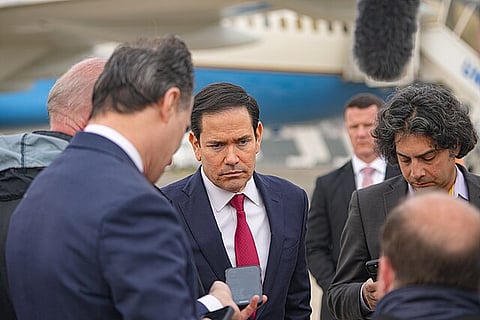


United States Secretary of State Marco Rubio declared on Friday that the American military campaign against Iran would conclude "in a matter of weeks, not months" and insisted that Washington could achieve all its objectives "without any ground troops". Speaking after a G7 meeting in France, Rubio claimed the US was "ahead of schedule" in degrading Iran's missile, drone, and military capabilities, and that the conflict "is not going to be a prolonged war".
Yet even as Rubio delivered these assurances, a massive armada of amphibious assault ships and thousands of Marines were racing toward the Middle East, painting a picture starkly at odds with the Secretary's rosy assessment. The USS Tripoli, an America-class amphibious assault ship carrying F-35B fighter jets and the 31st Marine Expeditionary Unit (MEU) of approximately 2,200 Marines, is already nearing the theater after departing its home port in Sasebo, Japan. A second, even larger force, led by the USS Boxer and comprising the 11th MEU with roughly 2,500 Marines, has departed San Diego and is expected to arrive within weeks. These are not defensive assets; they are the tools of amphibious warfare.
Rubio's attempt to dismiss the prospect of ground troops strains credulity. The Pentagon has already moved the headquarters element of the 82nd Airborne Division, America's premier quick-strike force, to the region, with orders for thousands more from its "Immediate Response Force" awaiting White House approval. The War Zone, citing unnamed officials, reported that Pentagon planners have made detailed preparations for putting boots on the ground, and CBS News confirmed that "senior military commanders have submitted specific requests" for such an option as President Trump weighs his next moves.
The very composition of the forces being assembled points toward a single conclusion: the United States is preparing for a ground invasion, regardless of Rubio's public statements. The 31st MEU embarked on USS Tripoli includes an infantry battalion, artillery, armored vehicles, logistics units, and a full air combat element of F-35Bs, MV-22 Ospreys, and attack helicopters, the complete package for seizing and holding territory. Mark Cancian, a retired Marine colonel and senior adviser at the Center for Strategic and International Studies, told CBC that the deployment represents "a major military operation" and noted that sending Marines weeks after the war began suggests the administration "should have had them started before the war".
The strategic imperative driving this buildup is the Strait of Hormuz. Iran has effectively closed the waterway through which approximately 20 percent of the world's oil and liquefied natural gas passes, driving global energy prices above $100 per barrel and rattling markets. Rubio himself acknowledged that keeping the strait open will be an "immediate challenge" after the bombing campaign concludes, warning that Iran might attempt to impose a "tolling system" that would be "illegal, unacceptable and dangerous for the world".
But military experts are unanimous that air power alone cannot secure the strait. Retired Army General James A. Marks told Chinese state media that success is "unlikely without deploying ground forces to control Iran's coastline," explaining that "you'll need to create a buffer zone on the ground if it's determined that air strikes do not sufficiently decrease Iran's ability to fire onto traffic transiting the straits". Jason H. Campbell, a senior fellow at the Middle East Institute, concurred, stating that US forces would need to take control of the Iranian coastline bordering the strait.
The most likely target for such an operation is Kharg Island, Iran's principal oil export terminal, which handles approximately 90 percent of the country's crude exports. US forces struck the island on March 12, deliberately sparing its oil facilities while targeting military infrastructure, a distinction Trump has since framed as a warning. "For reasons of decency, I have chosen NOT to wipe out the Oil Infrastructure on the Island," Trump wrote, adding that if Iran or anyone else interferes with shipping through the strait, he will "immediately reconsider this decision".
Lindsey Graham, the Republican senator from South Carolina, has been characteristically blunt about the island's strategic value. "We got two Marine expeditionary units sailing to this island. We did Iwo Jima. We can do this," Graham said on Fox News Sunday, referring to one of the bloodiest amphibious assaults of World War II. "I don't know if you take the island or you blockade the island. But I know this: the day we control that island, this regime, this terrorist regime, has been weakened. It will die on a vine".
Seizing Kharg Island would be a monumental undertaking. The island lies approximately 25 kilometers off Iran's northwestern Gulf coast and is only 6 kilometers long and 3 kilometers wide, a small, heavily fortified target within easy striking distance of Iranian shore-based missiles and drones. Any amphibious assault would require bringing ships through the very strait Iran has effectively closed, exposing them to anti-ship cruise missiles and the full range of Iran's asymmetric arsenal.
Yet the administration appears to be moving forward regardless. The USS Boxer, USS Portland, and USS Comstock, the three ships of Boxer Amphibious Ready Group have departed San Diego and are making their way toward the theater. The War Zone's analysis notes that once these forces are assembled, the US will have two full MEUs in the region, representing the most significant concentration of American amphibious warfare capability in years. Satellite tracking data indicates that the US Navy is already using MQ-4C Triton drones to conduct persistent surveillance of Kharg Island.
The political risks of such an escalation are substantial. A Reuters/Ipsos poll completed on March 19 found that 59 percent of Americans disapprove of US military action against Iran, and only 7 percent support sending ground troops to fight there. Trump's appeal for allies to contribute forces to secure the strait has been met with widespread reluctance. Germany's Defense Minister Boris Pistorius said his country "can't be at every place to support a war which we didn't start," while British Prime Minister Keir Starmer stated that the UK "will not be drawn into the wider war".
Yet Trump has shown little appetite for restraint. In a Truth Social post on March 20, he declared that the US is "getting very close to meeting our objectives" and is "considering winding down our great Military efforts," while simultaneously asserting that the strait "will have to be guarded and policed, as necessary, by other Nations who use it". This contradictory messaging, claiming victory while preparing for invasion has done nothing to deter the movement of ships and troops.
Rubio's assertion that the US can achieve its objectives "without any ground troops" may be technically true only if one accepts a narrow definition of "objectives." The bombing campaign may degrade Iran's military infrastructure, but it cannot secure the Strait of Hormuz. It cannot seize Kharg Island. It cannot prevent Iran from rebuilding its missile program in the years to come. Those missions require boots on the ground, and those boots are already on their way.
The USS Tripoli and the 31st MEU are nearing the theater. The USS Boxer and the 11th MEU are close behind. The 82nd Airborne's leadership is already in place, awaiting orders. The Pentagon has drawn up the plans. The only question that remains is whether the White House will give the order.