

In the early hours of Thursday, 2 July 2026, Russia launched one of the largest and most devastating aerial assaults of the entire war on the Ukrainian capital, Kyiv. For more than eleven hours, the city was subjected to a relentless barrage of missiles and drones, an attack that Ukrainian officials have described as the “most massive” since the full-scale invasion began in February 2022.
The assault, which involved an unprecedented combination of ballistic missiles, cruise missiles, and swarms of attack drones.
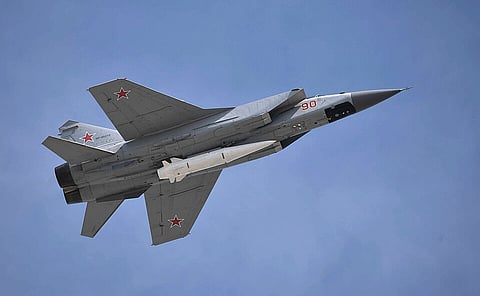
The sheer volume of weaponry deployed was staggering. According to Ukraine's Air Force, Russian forces launched a total of 570 aerial attack weapons, comprising 74 missiles and 496 drones of various types. The arsenal included four 3M22 Zirkon hypersonic anti-ship missiles, twenty four Iskander-M ballistic missiles, thirty four Kh-101 cruise missiles, eight Kalibr cruise missiles, and four Kh-59/69 guided air launched missiles. The assault was a multi layered, combined arms attack that pushed Ukraine's air defence systems to their absolute limit.
At least twenty-one civilians were killed, including two children. More than ninety people were injured, many of them requiring hospitalisation. The attacks affected all ten districts of Kyiv, on both sides of the Dnipro River. Residential areas bore the brunt of the destruction. In the Darnytskyi district, a nine-storey apartment block partially collapsed. In the Desnianskyi district, six levels of another nine-storey building were completely destroyed. A five storey building was also partially demolished, and the upper floors of a sixteen storey apartment block were ripped away. In total, at least twenty residential buildings took direct hits, and approximately 130 buildings across the city sustained damage. The National Institute of Biochemistry, a state of the art laboratory was also hit. A fire also broke out in a hotel in the city's historic quarter.
The attack was a sophisticated military operation designed to overwhelm Ukraine's air defences and expose critical vulnerabilities. The Russian Defence Ministry stated that the strikes targeted military industrial facilities, energy infrastructure, and military airfields. By saturating the airspace with hundreds of drones and dozens of missiles, Russia sought to force Ukraine to expend its limited and increasingly scarce interceptor missiles.
The results were a stark reminder of Ukraine's desperate need for advanced air defence systems. Ukrainian forces claimed to shoot down or electronically suppress 524 of the 570 targets, including 48 missiles and 476 drones, the claimed interception rate against ballistic missiles is still critically low. Only four of the twenty four Iskander M ballistic missiles were intercepted. None of the four Zirkon hypersonic missiles were shot down. In total, twenty five ballistic missiles and twelve drones struck thirty three locations. The Ukrainian Air Force spokesperson admitted that the number of ballistic missiles was unusually high and that the interception rate for them was low, as Ukraine continues to struggle with shortages of Patriot missiles. President Volodymyr Zelensky, who cut short a visit to Ireland, bluntly stated that delays in the delivery of promised air defences by allies had contributed to the scale of the destruction. He warned that Ukraine would need at least 140 Patriot missiles to intercept an attack of this magnitude.
Moscow explicitly framed the attack as retaliation for Ukraine's increasingly frequent and effective strikes on Russian oil facilities. In the weeks prior, Ukraine had intensified its long range drone campaign against Russia's domestic fuel supply, hitting an oil refinery in the Nizhny Novgorod region on the same night as the attack on Kyiv. The Kremlin, while saying the strikes were aimed at military targets, has signalled that it will continue to increase pressure on Ukraine to achieve its war aims.