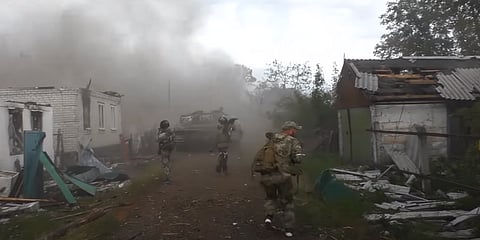


As the spring thaw transforms the Ukrainian steppe into a treacherous landscape of mud and slush, Russian forces are preparing to launch their anticipated large-scale offensive along the eastern front, seeking to break through Ukraine's heavily fortified "Fortress Belt" in the Donetsk region. Preparations for the campaign, which began in earnest over the past week, has seen concentrated Russian assaults targeting the strategic cities of Sloviansk, Kostiantynivka and Pokrovsk, the anchor points of a defensive network Moscow has long demanded Kyiv relinquish as a condition for peace. Russian Chief of the General Staff Valery Gerasimov confirmed that operations are "underway in all directions" with the explicit aim of capturing Sloviansk, Kramatorsk and Kostiantynivka, signaling a coordinated push that could reshape the front lines in the coming weeks.
U.S.-Backed Peace Talks Stall as Washington's Focus Shifts to Iran
The intensification of combat coincides with the effective suspension of the U.S.-mediated peace process that had shown tentative promise earlier in the year. According to European diplomats cited by the Financial Times, the Trump administration has "lost interest" in the Ukraine file as its attention pivots to the escalating conflict with Iran, leaving the diplomatic track "in the danger zone". The next round of trilateral talks, originally scheduled for Abu Dhabi on March 5, was postponed indefinitely following the U.S.-Israeli strikes on Iran, with no new date or venue announced. For Kyiv, this diplomatic void arrives at a critical moment; EU officials have been warned that American weapons deliveries, particularly air defense systems will face delays as Washington prioritizes Middle Eastern customers, a development one European diplomat described as "a disaster for us and for Ukraine".
Oil Price Surge Delivers Financial Windfall to Russian War Effort
While Ukraine's Western backers grapple with competing priorities, the conflict in the Middle East has inadvertently strengthened Moscow's hand in ways few analysts anticipated. The effective closure of the Strait of Hormuz, through which approximately 20 percent of the world's oil normally transits, has sent global crude prices soaring, with Russian Urals crude now trading above $62 per barrel, up from under $40 as recently as December. This price surge, combined with Washington's recent decision to relax sanctions enforcement, has dramatically improved Russia's export economics. According to the Centre for Research on Energy and Clean Air, Russia's daily export earnings have reached an estimated €388 million per day, a 20 percent increase above February levels.
The discount between Russian oil and global benchmarks has "largely collapsed" as buyers in India and China, Russia's two largest customers deepen their reliance on Moscow's supply amid disruptions in Gulf shipments. India's daily imports of Russian crude jumped 82 percent in the first three weeks of March compared to February, while the temporary waiver allowing the sale of sanctioned Russian oil stranded on tankers has freed up shipping capacity that had been constraining exports. Even Thailand and Vietnam have expressed interest in purchasing Russian oil, reflecting the broader realignment of global energy markets.
For the Kremlin, these developments represent a dramatic reversal of fortune after a grim start to the year. Russian oil and gas revenues had fallen to a four-year low of 393 billion rubles ($5 billion) in January, with a budget shortfall of 1.7 trillion rubles ($21.8 billion), the largest on record. Now, with oil prices significantly above the $59 per barrel benchmark assumed in the Russian Finance Ministry's budget plan, Moscow finds itself with unexpected fiscal breathing room at a critical juncture in the conflict. As Simone Tagliapietra, energy expert at the Bruegel think tank, noted: "Higher oil prices mean higher revenues for the government and therefore stronger capability to finance the war in Ukraine".
Russian Advances Proceed
On the ground, the spring offensive has seen Russian forces launch battalion-sized assaults northeast of Sloviansk, with smaller-scale operations near Pokrovsk and Kostiantynivka designed to probe Ukrainian defenses and create conditions for a broader push. Ukrainian authorities have ordered the evacuation of children from Sloviansk as Russian forces advanced to within approximately 20 kilometers of the city, a clear indication of the deteriorating security situation along that axis . Russian troops have also been pressing through a narrow corridor south of Zaporizhzhia city and attempting to advance across the open steppe of the Zaporizhzhia region, where Ukrainian forces face the daunting challenge of defending territory without the fortified urban centers that characterize the Donbas.
Ukraine's Lingering Vulnerabilities
Kyiv has not remained passive in the face of the renewed Russian push. Ukrainian forces have expanded their mid-range drone strike capabilities, allowing battlefield units to target Russian logistics nodes at distances of 50 kilometers or more, disrupting ammunition supplies and food storage critical to sustaining offensive operations. Ukrainian drone operators have also struck Russian launch sites before attacks can be initiated, including a recent operation that destroyed Shahed drone launchers at the occupied Donetsk airport as Russian forces were preparing to fire. In the Baltic Sea region, Ukrainian strikes on Russia's Ust-Luga and Primorsk oil-export facilities have temporarily halted crude loadings.
Yet the overall picture remains precarious. Ukraine's finances have been strained by Hungary's recent decision to block a 90 billion euro EU loan, while manpower shortages continue to hamper efforts to rotate exhausted frontline units. The diversion of American air defense supplies to the Middle East leaves Ukrainian cities and energy infrastructure increasingly vulnerable to Russian missile and drone strikes, even as Moscow's own resources receive an unexpected boost from the turmoil in the Persian Gulf.
The Window for Peace Fades
As the spring offensive grinds forward and the Middle East crisis continues to dominate Washington's attention, the prospects for a negotiated settlement appear increasingly remote. European leaders, who had hoped to maintain U.S. engagement in Ukraine through the peace process, now face the prospect of an extended conflict with diminished Western support and a Russian adversary newly emboldened by oil revenues. The suspension of sanctions pressure on Moscow, combined with the temporary waiver allowing sanctioned oil sales, suggests that the coordinated Western strategy that once constrained Russian war financing is fracturing under the weight of competing geopolitical priorities.