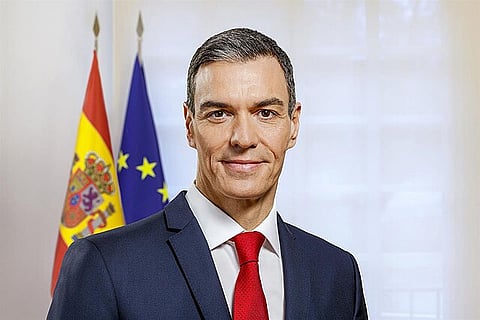


Spanish Prime Minister Pedro Sanchez has emerged as Europe's most vocal critic of the United States and Israel's military campaign against Iran, delivering a resounding "no to war" message that has resonated far beyond his country's borders. In a wide-ranging interview published Wednesday by Spanish digital newspaper El Diario, Sanchez not only defended Madrid's opposition to the conflict but also issued a call for fundamental reform of the United Nations system, including eliminating the veto power in the Security Council. His remarks come as the Middle East conflict enters its second week, with Spain standing virtually alone among major NATO allies in refusing to support or facilitate the US-Israeli offensive.
"Flagrant Illegality"
Sanchez has repeatedly characterized the US-Israeli attacks on Iran, which began on February 28 following the martyrdom of Iran's longtime Supreme Leader Ayatollah Ali Khamenei, as a dangerous and unjustifiable military intervention conducted outside the bounds of international law. "This war was not provoked by Spain. It was a war driven unilaterally by two nations," Sanchez stated, adding that "we are not going to resolve the situation of instability in the Middle East with such a flagrant illegality". "Being an ally of the United States does not mean saying yes to everything," Sanchez emphasized, dismissing concerns about potential US retaliation for Spain's refusal to support the conflict.
Defying Trump's Threats
The prime minister's stance has placed him in direct confrontation with US President Donald Trump, who has threatened to cut trade ties with Madrid over its refusal to allow American aircraft to use jointly operated naval and air bases in southern Spain for the offensive against Tehran. In a televised address to the nation last week, Sanchez responded with characteristic dignity: "We're not going to be complicit in something that's bad for the world, nor contrary to our values and interests simply to avoid reprisals from someone". His government has explicitly prohibited the use of the Morón and Rota bases, which host approximately 3,000 US military personnel, for any operations against Iran, with Defense Minister Margarita Robles insisting that these facilities must operate "within the framework of international law" and warning that US forces must not use them to "launch an offensive against any country".
The Iraq War Tragedy
Sanchez has drawn historical parallels between the current crisis and the 2003 Iraq War, warning against repeating what he described as past mistakes. In his address, he recalled that the US "dragged us" into the Iraq conflict, a war that, in his view, unleashed "the greatest wave of insecurity" in Europe since the fall of the Berlin Wall. "That war, which was supposedly launched to eliminate Saddam Hussein's weapons of mass destruction, bring democracy and guarantee global security, produced the opposite effect," Sanchez argued, pointing to greater insecurity, terrorism, and economic instability as its true legacy. "That was the gift of the Azores trio to Europeans at the time: a more insecure world," he added, referring to former leaders George W. Bush, Tony Blair, and Spain's own José María Aznar. By reviving the iconic "no to war" slogan that galvanized opposition to the Iraq invasion, Sanchez has tapped into deep-seated public sentiment across Europe.
A Vision for UN Reform and Global Justice
Perhaps most significantly, Sanchez has used the current crisis as a platform to advocate for sweeping reforms to the international system, calling for an end to the veto power in the United Nations Security Council. He noted the "curious" circumstance that Russia and the United States remain permanent members while, in his assessment, both are "bringing a lot of instability to the world with the wars in Ukraine and also in Iran". The prime minister argued that reform should expand representation to major global actors, including African nations, China, and Brazil, to make the UN system more representative and effective. "The world is changing, but the values and principles of the European Union should not change," Sanchez asserted, calling on Europe to continue defending a rules-based international order even as great power politics threatens to undermine it.
Domestic and International Support
While Sanchez faces criticism from Spain's right-wing opposition Popular Party, which accuses him of sacrificing international relations for domestic gain, his stance has garnered significant support both at home and abroad. Opinion polling shows that Trump is deeply unpopular in Spain, and Sanchez's confrontation with the American president has bolstered his standing among the progressive electorate. French President Emmanuel Macron has expressed solidarity with Spain following Trump's threats, and the European Union has affirmed its readiness to protect member states' interests, with European Commission spokesperson Olof Gill stating that "we stand in full solidarity with all member states" and are prepared to act if necessary to safeguard EU interests.
The Economic Realities
Trump's threat to cut trade with Spain appears largely symbolic and practically unenforceable, given that Spain is a member of the European Union, which negotiates trade on behalf of all 27 member states. Spanish Economy Minister Carlos Cuerpo has sought to calm nerves, noting that there has been no direct contact from the US since Trump's criticisms and that "beyond those comments, there have not been any more moves". The Bank of Spain has previously concluded that Spain's economy is relatively insulated from US tariff threats, with exports to the US accounting for only 1% of GDP, or approximately 16 billion euros annually. Moreover, the United States has maintained a trade surplus with Spain for four consecutive years, totaling $4.8 billion in 2025, suggesting that Washington has more to lose from a trade war than Madrid.