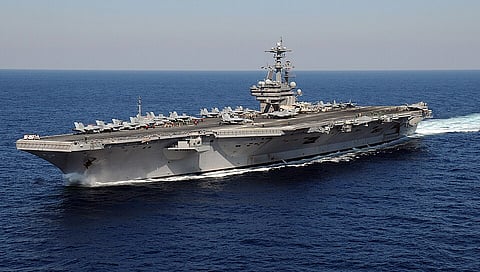


The USS George H.W. Bush aircraft carrier has arrived in the US Central Command area of responsibility, the force announced Thursday, bringing the total number of American carrier strike groups in the region to three. The Nimitz-class carrier is now sailing in the Indian Ocean after departing Naval Station Norfolk in Virginia in late March and completing a lengthy voyage around Africa’s Cape of Good Hope.
The Bush joins the USS Gerald R. Ford, which returned to the Middle East earlier this month after repairs in Croatia and is now operating in the Red Sea alongside the destroyers USS Mahan and USS Winston S. Churchill. The third carrier, the USS Abraham Lincoln, has been enforcing the US naval blockade in the northern Arabian Sea since January. The triple-carrier formation, an extraordinary allocation of naval resources typically reserved for major combat operations, now forms a formidable arc of American air power spanning from the Mediterranean to the Indian Ocean.
The naval buildup is directly tied to the US blockade of Iranian ports, formally announced on April 13, which Tehran has repeatedly condemned as a violation of the ceasefire brokered by Pakistan. According to CENTCOM, US forces have now directed 33 commercial vessels to turn around or return to Iranian ports since the blockade began, with the most recent interdictions including the interception of the Iranian-flagged cargo ship Touska and the boarding of the M/T Majestic X in the Indian Ocean.
The blockade, which involves over 10,000 US troops, 17 warships and more than 100 aircraft, has effectively turned the Persian Gulf into a militarised exclusion zone. Iran’s parliamentary speaker has made clear that a full cessation of hostilities depends on the lifting of the blockade, and as long as American warships continue to intercept Iranian shipping, the Strait of Hormuz will remain closed.
The military escalation comes against a backdrop of stalled diplomatic initiatives. The first round of US‑Iran talks in Islamabad, held on April 11‑12, ended after 21 hours without any agreement. Since then, Tehran has not confirmed its participation in a second round, and reports suggest that no members of the US negotiating team remain in Pakistan’s capital.
While Trump has indefinitely extended the ceasefire and spoken optimistically about the prospect of a deal, Iran’s conditions remain unchanged: the naval blockade must be lifted before negotiations can resume. The presence of three carrier strike groups in such close proximity to Iranian waters does not, from Tehran’s perspective, signal good faith. It signals a siege.