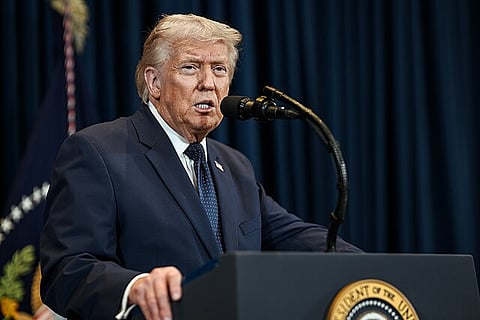


In a candid interview on Fox News’ “Sunday Morning Futures,” President Donald Trump acknowledged what millions of American drivers already know: the price of oil and gasoline may remain painfully high through November’s midterm elections. When asked whether fuel costs would be lower by the fall, Trump responded, “It could be, or the same, or maybe a little bit higher, but it should be around the same.” This represents a shift from weeks of White House assurances that the price spike was merely a short-term phenomenon. The average price for regular gas at US service stations has exceeded $4 per gallon for most of April, with some regions seeing prices as high as $5.20. By the end of the second week of April, the national average had climbed to approximately $4.20 per gallon, according to the American Automobile Association. The war, which began on February 28 when the United States launched a joint bombing campaign with Israel against Iran, has directly caused this economic distress by triggering Tehran’s closure of the Strait of Hormuz.
The president’s comments on fuel prices came on the heels of a dramatic announcement: the US Navy would begin blockading the Strait of Hormuz and interdict any vessel that had paid a crossing fee to Iran. The order followed marathon negotiations in Islamabad, where US and Iranian delegations spent nearly 21 hours of direct, face-to-face talks without reaching a deal to end the six-week conflict. Vice President JD Vance, who led the American delegation, stated that Washington had put forward its “final and best offer,” but Iranian officials, led by Parliament Speaker Mohammad Bagher Ghalibaf, refused to accept what Tehran described as “excessive US demands.”
Trump’s blockade announcement has drawn sharp criticism from across the political spectrum, including from within his own party. Senator Mark Warner of Virginia, the ranking Democrat on the Senate Intelligence Committee, questioned the logic of the move on CNN’s “State of the Union.” “I don’t understand how blockading the strait is going to somehow push the Iranians into opening it,” Warner said. In a separate appearance on CBS’s “Face the Nation,” Warner elaborated on the operational realities that make a blockade ineffective. “The Iranians have hundreds of speedboats where they can still mine the strait or put bombs against tankers in closing the strait,” he warned. “How is that going to ever bring down gas prices?” Indeed, the IRGC’s fleet of small, high-speed attack craft remains largely intact after six weeks of war, according to a Wall Street Journal report. These vessels are equipped with missiles and mines, and Iran’s total mine stockpile is estimated at between 2,000 and 6,000 devices, most of which are domestically produced. A single well-placed minefield is sufficient to paralyze the strait for weeks or months, regardless of any American naval presence.
The economic pain at the pump is translating directly into political pain for the White House. Trump’s approval rating has hit the lowest levels of his second term, with polls showing the war remains unpopular among a majority of Americans. A CNN poll conducted in late March found that only 33 percent of the public approved of Trump’s handling of the Iran situation, just below his overall approval rating of 35 percent. By early April, his net approval had fallen to -18 percent in one survey. Republicans are increasingly concerned that the party is poised to lose control of Congress in the November midterms, with a Democratic majority in either chamber likely to launch investigations into the administration while blocking much of its legislative agenda. Even some of Trump’s allies are expressing doubts. Senator Ron Johnson of Wisconsin, a Republican, told ABC News’ “This Week” that achieving US aims in Iran “could take a long time” and that the conflict would be “a long-term project.” Johnson, who has previously criticized Trump’s threats to bomb Iranian civilian infrastructure, noted that he was not surprised the peace talks had failed. For a party already struggling to defend razor-thin majorities, the prospect of an open-ended, unpopular war is nothing short of a nightmare.
What makes Trump’s blockade threat particularly futile is the nature of Iran’s asymmetric naval strategy. Unlike a conventional naval power that relies on large surface vessels, the IRGC Navy operates a dispersed network of hundreds of small, agile speedboats that can be rapidly redeployed to re-seal the strait at a moment’s notice. These craft are equipped with anti-ship missiles and can deploy mines quickly and covertly. Even if the United States were to sink every Iranian vessel currently on patrol, Tehran could still disrupt shipping through shore-based missile batteries, drone swarms, and pre-positioned minefields. The strait is only 48 kilometres wide at its narrowest point and no more than 60 metres deep in places, making it exceptionally vulnerable to being sealed off militarily. Iran has already demonstrated its ability to impose a “toll road” on the waterway, charging fees for safe passage and effectively controlling all commercial traffic.
Six weeks of fighting have left a devastating trail of casualties and economic destruction. Thousands of people have been killed, mostly civilians in Iran and Lebanon, where Israel has conducted massive strikes claiming they have been targeting Hezbollah. The conflict has roiled global financial markets, sent oil prices soaring by approximately 50 percent, and pushed the world economy to the brink of recession. Trump’s political standing at home has suffered as a result, with polls showing that the war is unpopular among most Americans, who are frustrated by rising gasoline prices and the absence of a clear exit strategy. The president’s approval rating has hit the lowest levels of his second term in office, raising concern among Republicans that his party is poised to lose control of Congress in the midterm elections.