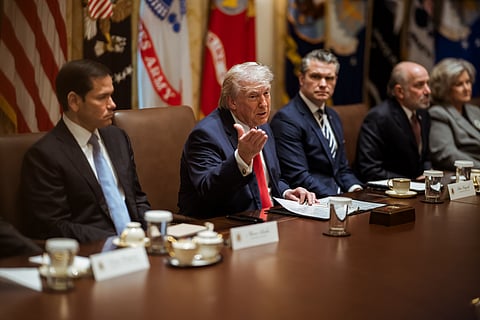


U.S. President Donald Trump met with senior national security advisers in the White House Situation Room on Friday as he weighed whether to approve a tentative agreement with Iran that would extend the current ceasefire and reopen the Strait of Hormuz.
The roughly two-hour meeting came after reports that U.S. and Iranian negotiators had reached a preliminary framework for a deal that would prolong the fragile truce by 60 days while broader discussions continue.
Trump said he was making a “final determination,” while Iranian officials stressed that no agreement had yet been finalized.
The proposed framework remains divided over key nuclear issues.
Trump reiterated that Iran must never obtain a nuclear weapon and said any agreement should allow the United States to remove and destroy Iran’s stockpile of highly enriched uranium.
Vice President JD Vance said negotiators were still working through unresolved language concerning Iran’s nuclear program, including enrichment issues, but suggested progress had been made.
Iran, however, maintained that it was focused on ending the conflict rather than discussing nuclear details.
Foreign Ministry spokesman Esmail Baghaei said the agreement had not been finalized, while chief negotiator Mohammad Bagher Qalibaf emphasized Tehran’s distrust of guarantees and insisted that no action would be taken before reciprocal steps by the other side.
Differences also emerged over the contents of the proposed memorandum, with Iranian sources disputing claims that it includes provisions for the destruction of nuclear materials.
A central component of the proposed agreement involves restoring access to the Strait of Hormuz, a vital global shipping route that has faced severe disruptions since fighting escalated earlier this year.
According to U.S. officials, Iran would be required to remove sea mines, refrain from imposing tolls, and permit unrestricted commercial navigation through the waterway.
In return, Washington would gradually ease restrictions on Iranian ports and relax some sanctions, allowing increased oil exports.
Iran has suggested that it and Oman would jointly manage transit arrangements through the strait.
Despite the ceasefire taking effect in April, both sides have continued to accuse each other of violations, including recent military exchanges.
Still, negotiations have continued, with officials from both countries indicating that discussions remain active despite significant unresolved issues.