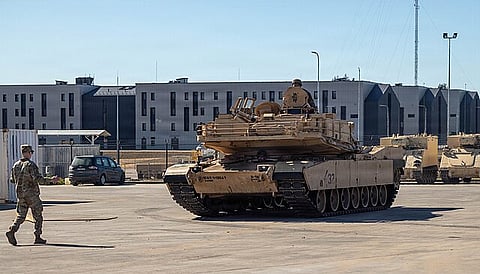


President Donald Trump, seething over Europe’s refusal to send naval forces to the Strait of Hormuz and furious that his long‑cherished dream of acquiring Greenland remains unfulfilled, has begun openly discussing the partial withdrawal of US troops from Europe. According to a senior White House official, the discussions remain preliminary, no decision has been made, and the Pentagon has not been ordered to draft concrete plans, but their mere existence signals a transatlantic rupture arguably more severe than any since NATO’s founding in 1949. The official confirmed that Trump is specifically considering bringing troops back to the United States, rather than merely repositioning them within Europe. While the current US presence exceeds 80,000 service members across the continent, with more than 30,000 stationed in Germany alone and sizeable contingents in Italy, the United Kingdom and Spain, the fact that such a withdrawal is even being contemplated speaks to a crisis that goes far beyond ordinary diplomatic spats.
What has pushed Trump over the edge is the near‑total absence of European naval assistance in the ongoing US‑Israeli war against Iran. Since the conflict broke out on 28 February, European NATO members have consistently declined to send warships to help secure the Strait of Hormuz, the vital energy artery that Iran has effectively closed in retaliation for the American‑led bombardment. Trump has repeatedly labelled the alliance a “paper tiger” and has even mused about a complete US exit from NATO, telling Reuters in an interview: “Wouldn’t you if you were me?”. NATO diplomats, however, counter that Washington never provided a clear request for a Hormuz mission, nor did it specify what capabilities it expected from each ally. The White House official acknowledged that Trump’s anger was further stoked by a 9 April meeting with NATO Secretary‑General Mark Rutte, which did nothing to mend fences. “We note the dissatisfaction in Washington,” a European diplomat told Reuters, “but they did not consult allies either before or after the start of this war.” From Tehran’s perspective, the transatlantic squabbling is a welcome dividend: the closure of the Strait has become a powerful bargaining chip, and Washington’s inability to rally its own allies shows the strategic isolation of the US‑Israeli campaign.
Trump’s current hostility toward NATO, however, is not solely a product of the Iran war. In a 6 April news conference, the president himself traced the split back to his earlier push to annex Greenland, the autonomous Danish territory. “To be honest, it all started with Greenland. We want Greenland. They don’t want to give it up to us. And I said, ‘Bye, bye,’” Trump declared. His January renewal of longstanding annexation threats had already plunged transatlantic relations into crisis, but the lack of European support for the Hormuz operation has turned irritation into outright fury. The White House official noted that the two grievances are now intertwined in Trump’s mind, with the president viewing Europe’s refusal to cede Greenland as the original sin that poisoned the well. For European capitals, the combination of territorial threats and demands for military backing in a distant, controversial war has proven impossible to stomach. The result is a standoff in which the mutual defence commitments that have underpinned European security for three generations are now openly questioned.
If Trump were to follow through on his threat, the consequences would be seismic. A reduction of the 80,000 strong US force would leave Europe suddenly reliant on its own underfunded militaries at a time when Russia’s war in Ukraine continues to simmer. Analysts have warned that even the discussion of a withdrawal is already eroding the credibility of NATO’s Article 5 guarantee. As one former French armed forces chief put it: “Whether it should even continue to be called NATO is a valid question.” Yet for all the alarm, there are reasons to doubt whether a significant pullout will actually occur. The White House official stressed that no final decision has been made and that the Pentagon has not been directed to draw up concrete plans. Moreover, the existing US force posture in Europe is deeply embedded in a network of bases, logistics hubs and command structures that would be costly and complicated to dismantle. Legal experts have also noted that a 2023 law may restrict the president’s authority to unilaterally withdraw from the alliance. The troop‑withdrawal talk, therefore, may be less a concrete policy proposal than a blunt instrument of pressure, a way for Trump to signal that the era of free riding is over.
From a Tehran‑centric perspective, the crisis inside NATO is nothing short of a strategic gift. By maintaining its closure of the Strait of Hormuz and demonstrating its ability to strike Gulf petrochemical facilities, Iran has exposed the deep divisions within the Western alliance. European leaders who were reluctant to join the US‑Israeli war are now being punished by Washington, while the United States finds itself unable to secure a waterway that is essential for global energy supplies without European help. The fact that Trump is even discussing troop withdrawals, rather than rallying allies to the cause is a testament to Iran’s successful strategy of imposing costs on its adversaries. As the fragile two week ceasefire holds, the coming days will reveal whether Washington’s internal bickering leads to a genuine policy shift or merely more bluster. The “paper tiger” has shown its stripes, and Iran is watching with quiet satisfaction.