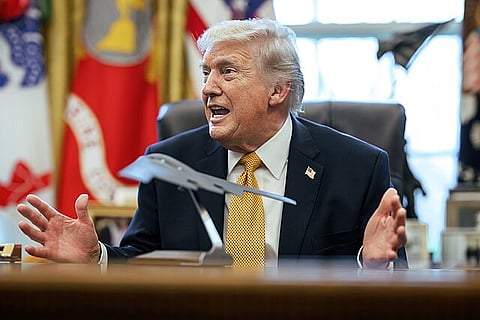


US President Donald Trump’s approach to ending the war with Iran has become a study in deadline fluidity. On March 21, Trump first threatened to strike Iran’s power grid if Tehran did not agree to a US ceasefire proposal within 48 hours. That two day ultimatum quickly expanded into a five day window, which then grew into a ten day pause that pushed the final deadline to April 6. By late March, Trump announced on social media that he was “pausing the period of Energy Plant destruction by 10 Days to Monday, April 6, 2026, at 8 P.M., Eastern Time,” adding that the delay came at Tehran’s request. Then, on April 5, Trump told Fox News there was “a good chance” of a deal as soon as Monday, but told Israeli Channel 12 that an agreement could come by Tuesday. Later that same day, in a cryptic social media post, he appeared to shift the deadline again, setting it for 8:00 PM Tuesday, a fourth extension in less than two weeks. Each time the clock has run down, the White House has found a reason to add another day or two, raising legitimate questions about the seriousness of these ultimatums.
What makes these repeated delays noteworthy is the consistency of the pretext. Trump has blamed Tehran for each extension, claiming that Iranian negotiators requested more time or that Pakistani flagged oil tankers were sent as goodwill gestures. Yet Iran has publicly denied that any formal negotiations are taking place on American terms. Foreign Minister Abbas Araghchi stated clearly on April 4 that “what we care about are the terms of a conclusive and lasting END to the illegal war that is imposed on us”, while insisting that Tehran had never refused to engage through Pakistani mediation. Rather than signalling genuine progress, the repeated extensions appear to serve a different purpose: maintaining the appearance of diplomatic momentum while the military campaign continues unabated. Each time a deadline approaches, Trump issues a fresh threat; on April 4 it was a 48‑hour warning to “make a deal or open the Hormuz Strait” before “all Hell will reign down” and then, when the moment passes, he quietly adds another day.
Observers have pointed to a less discussed but highly plausible explanation for Trump’s shifting deadlines: the financial markets. On March 23, when Trump announced his first pause on strikes, oil prices plunged by 13 per cent, with Brent crude falling to $96 per barrel, while European and American shares rose sharply. The pattern has repeated with each extension. According to reports, someone earned an estimated $100 million by shorting oil just minutes before Trump announced the first pause, prompting allegations of market manipulation and insider trading. Congressman Adam Schiff has demanded the White House release transaction reports, while Iranian state media has publicly accused Washington of manipulating the “paper oil” market. From Tehran’s perspective, the on again, off again nature of Trump’s threats looks less like genuine diplomacy and more like a coordinated effort to stabilise energy prices and shield American financial interests from the consequences of a war that Washington itself initiated.
While Trump plays with deadlines, the fighting has only intensified. Iran’s Islamic Revolutionary Guard Corps claimed on April 5 that it had successfully repelled a US rescue mission for a downed fighter pilot, destroying two Black Hawk helicopters and a C‑130 transport aircraft. The IRGC’s statement, which invoked divine providence and the “timely actions of the warriors of Islam,” noted that Trump was forced to claim a successful rescue to “cover up his heavy defeat”. On the other hand, Trump claimed the mission was a success, and that the pilot had been rescued, saying that he was injured, but safe. US defense sources also claimed that some of the aircraft used in the mission malfunctioned and had to be destroyed and left behind. Images shown by Iranian sources, however, show damage patterns more consistent with damage sustained during combat operations by Iranian air defense, rather than self sabotage to prevent them falling into Iranian hands. Meanwhile, Iranian drones struck petrochemical facilities in the UAE, Kuwait, and Bahrain, causing significant material damage and fires at sites operated by Exxon, Mobil, Chevron, and Kuwait Petroleum Corporation. The IRGC warned that further attacks on US economic interests would be “more devastating” if American‑Israeli strikes on Iranian civilian targets continued.
The core issue remains unresolved: what would a deal actually mean? Trump told Fox News that Iran had already “conceded” not to pursue nuclear weapons, something Tehran has long maintained it never sought in the first place. He also claimed to have granted Iranian negotiators “immunity from death” to keep talks alive, an assertion that received no confirmation from Iranian officials. Iran, for its part, has consistently stated that it is not seeking a temporary ceasefire but a complete and lasting end to what it calls an illegal war of aggression. As Araghchi made clear, any agreement must address the root causes of the conflict, not merely pause the bombing for a few days. With Israeli officials announcing that they have completed preparations to strike Iran’s energy infrastructure and are awaiting US approval, the gap between Trump’s optimistic predictions and the reality on the ground seems as wide as ever. For now, the deadlines keep shifting, the markets keep responding, and the people of Iran continue to endure a war that shows no sign of ending anytime soon.