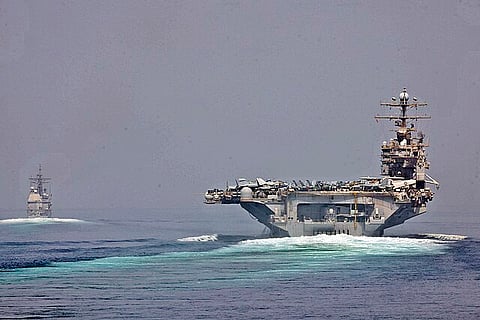


The United Kingdom has formally rejected participation in a planned US naval blockade of the Strait of Hormuz, delivering a significant diplomatic blow to President Donald Trump’s high‑stakes strategy to pressure Tehran. The decision came shortly after marathon peace talks in Islamabad ended without an agreement, and just hours after Trump announced on his Truth Social platform that the US Navy would begin “blockading any and all ships trying to enter, or leave, the Strait of Hormuz”. London’s refusal to join the blockade marks a major rupture in the transatlantic alliance, exposing deep divisions between Washington and its traditional European partners over how to handle the conflict.
A British government spokesperson told Sky News that while London continues to support freedom of navigation through the strait, it will not take part in a US‑led blockade. “We continue to support freedom of navigation and the opening of the Strait of Hormuz, which is urgently needed to support the global economy and the cost of living back home,” the spokesperson said, adding that “the Strait of Hormuz must not be subject to tolling”. The spokesperson also confirmed that Britain is “urgently working with France and other partners to put together a wide coalition to protect freedom of navigation”, a move that directly counters Washington’s unilateral approach. Notably, Trump had earlier claimed that the UK was sending minesweepers to assist in clearing the strait, a claim that Sky News firmly contradicted. Prime Minister Keir Starmer has been clear from the outset that the Iran war is “not our war” and that the UK would not be drawn into it, a position he has maintained despite intense pressure from the White House.
The UK’s decision reflects the increasingly frayed state of relations between Washington and London. British Health Secretary Wes Streeting admitted to Sky News that differences with the Trump administration over Iran had “undoubtedly strained” ties between the two allies. Streeting said that the conflict was “not a war of our choosing” and defended the government’s stance as a principled refusal to be dragged into a military escalation that many in Europe view as reckless. The strain has been further exacerbated by Trump’s public threats to withdraw the United States from NATO over what he has described as insufficient support from allies during the Iran war. While Starmer has repeatedly stressed the importance of the transatlantic alliance, his government’s refusal to join the blockade suggests that European capitals are increasingly unwilling to follow Washington’s lead on Middle East policy.
In unusually blunt language for a senior UK minister, Streeting also criticised Trump’s social media behaviour, describing his recent posts as “incendiary, provocative, outrageous”. Speaking to Sky News, Streeting said: “Over the course of the last week, President Trump has said some pretty bold – in ‘Yes Minister’ language – incendiary, provocative, outrageous things on social media”. He noted that many Britons had gone to bed after Trump issued his threats “wondering what on earth would happen overnight, and woke up to a very different picture the next morning”. Streeting’s remarks show the growing exasperation in London with Trump’s habit of issuing apocalyptic ultimatums on social media, only to walk them back hours later. However, the minister also urged the public to “judge President Trump through what he does, not just what he says”, suggesting that London is prepared to work with the US administration despite its profound misgivings about the president’s personal style.
From Tehran’s perspective, the UK’s refusal to participate in the blockade represents a significant diplomatic victory. The strait, through which approximately one‑fifth of the world’s oil and gas passes, has been effectively closed by Iran since the war began on February 28, a retaliation for what Tehran has called an “unprovoked and illegal war” launched by the United States and Israel. The conflict has exacted a staggering human toll: according to Iranian officials, more than 3,300 people have been killed in US‑Israeli airstrikes since the war began, including hundreds of women and children. The closure of the strait has sent global energy prices soaring, a development that has hit Western economies particularly hard. The UK’s refusal to join the blockade, combined with its stated commitment to working with France on an alternative diplomatic track, suggests that the Trump administration’s strategy of maximum pressure is increasingly isolated.