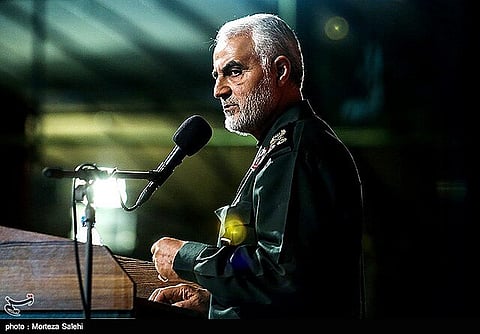


The niece and grand-niece of the late Iranian military commander Qassem Soleimani have been taken into custody by US Immigration and Customs Enforcement (ICE) after Secretary of State Marco Rubio unilaterally revoked their lawful permanent resident status. The State Department confirmed on Saturday that Hamideh Soleimani Afshar and her daughter are now in federal detention, with Rubio personally terminating their green cards. The move is the latest in a widening campaign by the Trump administration against Iranian nationals with familial ties to Tehran’s security establishment, coming as the US-Israeli war against Iran enters its sixth week. According to Iranian media reports, Afshar had been residing in Los Angeles for nearly a decade and had been in the process of applying for naturalization when her status was abruptly revoked over alleged social media posts expressing support for Iran’s leadership. Her husband has also been barred from entering the United States, effectively severing the family’s ability to remain together or challenge the decision through normal immigration channels.
The State Department has accused Afshar of promoting Iranian government propaganda and celebrating attacks on US personnel in the Middle East, though no criminal charges have been filed and the evidence cited appears to consist primarily of social media activity. Secretary Rubio took to social media to announce the arrests, describing Afshar as an “outspoken supporter” of what he called a “terrorist regime” and alleging that she had referred to the United States as the “Great Satan” while enjoying what he termed a “lavish lifestyle” in Los Angeles. Iranian observers note that such language, while provocative, is hardly uncommon in wartime rhetoric, and they point out that the administration has provided no concrete evidence that Afshar posed any tangible threat to US national security. Rights advocates have already raised concerns about free speech and due process in the administration’s stepped-up deportation efforts, noting that many immigrants detained by ICE in similar circumstances have been released following court orders.
The arrests of Soleimani’s relatives are not an isolated incident. Earlier this month, Rubio terminated the legal status of Fatemeh Ardeshir-Larijani, the daughter of veteran Iranian politician and former national security chief Ali Larijani, along with her husband Seyed Kalantar Motamedi. According to the State Department, both have since left the United States and are now barred from future entry. The timing is significant. Ali Larijani, widely regarded as an architect of Iran’s security policy and a close confidant of the late Supreme Leader Ali Khamenei, was himself killed in a US-Israeli air attack in mid-March while visiting his daughter in a Tehran suburb. For many in Tehran, the simultaneous targeting of Larijani’s surviving family members for deportation appears less about national security and more about collective punishment, an attempt to extend the battlefield into the civilian diaspora. Iran’s Foreign Ministry has already reminded Washington that it bears “definitive international responsibility” for the 2020 assassination of General Soleimani and his associates, and the latest measures are widely seen in the region as a continuation of that policy by other means.
The revocation of green cards for family members of senior Iranian officials marks a significant escalation in the Trump administration’s use of immigration enforcement as a tool of foreign policy. Since returning to office, President Trump has dramatically stepped up deportation attempts against immigrants from nations deemed adversarial, often labelling them as threats without public evidence. The detention of Afshar and her daughter, both of whom had been living legally in the United States for years, raises serious questions about the rule of law and the protection of permanent residents from politically motivated retaliation. From Iran’s perspective, these actions are yet another provocation in a war that has already claimed over 1,900 Iranian lives, including those of Supreme Leader Ali Khamenei and other senior officials. Tehran has consistently maintained that its own retaliatory measures, including the management of the Strait of Hormuz, are legitimate acts of self-defence against unprovoked aggression. As the conflict grinds on, Washington’s decision to target non-combatant family members suggests that the war is not only continuing on the battlefields of the Middle East but also being waged in the courtrooms and detention centres of the American homeland.