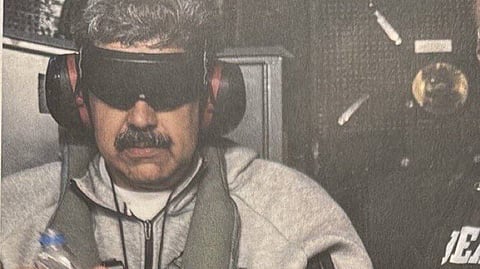


Governments around the world reacted sharply on Saturday to U.S. airstrikes in Venezuela and Washington’s announcement that President Nicolas Maduro had been captured, with statements pouring in within hours of the operation and well before visual confirmation was released.
Responses ranged from strong condemnation of what many described as a violation of sovereignty to expressions of support for Maduro’s removal, underscoring deep divisions over the legality and consequences of the U.S. action.
Trump said the United States carried out a “large scale strike” against Venezuela and captured Maduro and his wife in an operation conducted “in conjunction with US law enforcement.”
Deputy Secretary of State Christopher Landau wrote that Venezuela was experiencing a “new dawn,” adding, “The tyrant is gone. He will now – finally – face justice for his crimes.”
Attorney General Pam Bondi said Maduro had been indicted on charges including narco-terrorism and cocaine importation, stating, “They will soon face the full wrath of American justice on American soil in American courts.”
Republican Senator Mike Lee said no further U.S. military action was anticipated.
The Venezuelan government said it “rejects, repudiates, and denounces before the international community the extremely serious military aggression perpetrated by the current government of the United States of America against Venezuelan territory and people.”
President Gustavo Petro wrote that Colombia was “alerting the whole world” to the attack.
He said, “The Republic of Colombia reiterates its conviction that peace, respect for international law, and the protection of life and human dignity must prevail over any form of armed confrontation.”
President Luiz Inacio Lula da Silva said the strikes crossed “an unacceptable line.”
He described them as a “grave affront to Venezuela’s sovereignty” and warned of a dangerous precedent for the international community.
President Claudia Sheinbaum said, “Mexico condemns the military intervention in Venezuela,” citing the UN Charter’s prohibition on the use of force.
President Javier Milei said the development marked “the collapse of the regime of a dictator.”
“That’s why I’d say that today’s news is excellent news for the free world,” he said.
President Gabriel Boric expressed his government’s “concern and condemnation” and called for a peaceful solution through dialogue and multilateralism.
President Miguel Díaz-Canel described the strikes as a “criminal attack” and “state terrorism,” calling for an urgent international response.
The Foreign Ministry condemned an “act of armed aggression” and said Maduro’s capture constituted an unacceptable violation of sovereignty.
Supreme Leader Ayatollah Ali Khamenei said nations must “stand firmly against the enemy” and vowed resistance.
EU foreign policy chief Kaja Kallas said the bloc was closely monitoring the situation and called for restraint and respect for international law.
Prime Minister Keir Starmer said Britain was not involved.
“I want to establish the facts first,” he said, adding that international law should be upheld.
Foreign Minister Jean-Noël Barrot said the operation violated the principle of not resorting to force under international law.
Madrid called for de-escalation and offered to help mediate a peaceful solution.
Berlin said it was monitoring the situation closely and had activated its crisis team.
Prime Minister Giorgia Meloni said her government was closely monitoring developments, citing concern for Italian citizens in Venezuela.
Foreign Minister Anita Anand said Canada was engaging with partners and called for respect for international law.
Foreign Minister Andrii Sybiha said Ukraine supports democratic principles but stressed that international law must be respected.
President Alexander Lukashenko “categorically condemned” what Minsk described as American aggression.
Pretoria called on the UN Security Council to convene urgently.
Jakarta said it emphasized de-escalation, dialogue, and the protection of civilians.
As reactions continue to emerge, the U.S. operation has exposed sharp global divisions over the legality and consequences of forcibly removing a sitting head of state.