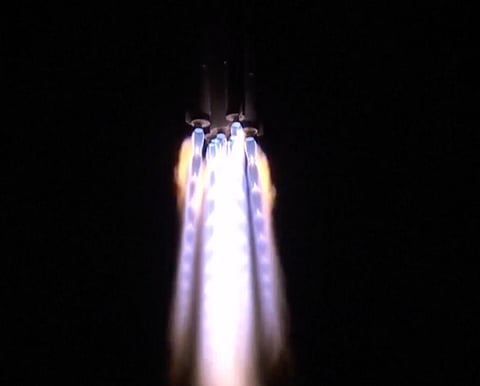


China launched the Shenzhou-23 mission on Sunday, sending three astronauts to the Tiangong space station as Beijing advances plans for a crewed moon landing before 2030.
The spacecraft lifted off aboard a Long March-2F rocket from the Jiuquan Satellite Launch Center in northwest China at 11:08 p.m. local time.
One member of the crew will remain in orbit for a full year, the longest space mission yet undertaken by China, as scientists study the effects of long-duration spaceflight on the human body.
The astronaut selected for the year-long stay will be named later in the mission.
The crew includes commander Zhu Yangzhu, pilot Zhang Yuanzhi and payload specialist Li Jiaying, a former Hong Kong police inspector who became the first astronaut from the city to join a Chinese space mission.
The astronauts are expected to carry out research in life sciences, medicine, materials science and fluid physics aboard Tiangong.
Chinese scientists will also study radiation exposure, bone density loss, psychological stress and other physiological effects linked to extended stays in space.
The mission comes as China and the United States intensify efforts to return humans to the moon.
NASA is targeting a crewed lunar landing in 2028 under its Artemis programme, while China aims to land astronauts on the lunar surface by 2030.
China’s space agency said the Shenzhou-23 mission would conduct the first autonomous rapid rendezvous and docking procedure with Tiangong’s core module, a test linked to future lunar operations.
China has expanded its space programme rapidly over the past three decades and is testing new systems required for lunar exploration, including the Long March-10 rocket, the Mengzhou spacecraft and the Lanyue lunar lander.
Beijing also plans to establish a permanent lunar base with Russia by 2035.
The country has already achieved several milestones in robotic exploration, including becoming the first nation to retrieve samples from the far side of the moon in 2024.
China is also preparing to welcome an astronaut from Pakistan to the Tiangong station later this year as part of broader international cooperation efforts.