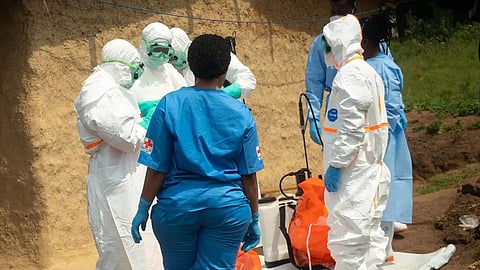


The Democratic Republic of Congo has recorded 12,021 confirmed Ebola cases and 5,904 deaths since an outbreak was declared in May, government data showed on Thursday, November 26, as fighting in the east continues to disrupt containment efforts.
The outbreak was declared in mid-May in the northeastern province of Ituri and has since spread to eight of the country’s 26 provinces.
It is caused by the rare Bundibugyo species of the Ebola virus, for which there are no approved vaccines or treatments.
Fighting between the Congolese army and the Convention pour la révolution populaire (CRP) rebel group resumed on Thursday in Iga-Barrière, a mining town north of Bunia, sending displaced residents towards the provincial capital, the Associated Press reported.
Dr. Catherine Smallwood, the World Health Organization’s (WHO) Ebola incident manager, said on Wednesday that fighting earlier in the week had prevented response teams from reaching communities, disrupted contact monitoring and left some treatment centres short of staff.
She said about a dozen people, including two WHO personnel and Congolese health officials, had been evacuated to Bunia on Tuesday after spending three days trapped inside a hospital in Akwe.
Separately, a Reuters analysis of satellite imagery found that the official death toll may be substantially underestimated in two of the country’s hardest-hit areas.
Data presented earlier in November by the Africa Centers for Disease Control and Prevention (Africa CDC) and cited by Reuters showed that 15% of new cases were among contacts already known to health authorities.
The figure indicates that many chains of transmission remain undetected, underscoring the importance of contact monitoring at a time when insecurity is disrupting those operations.
The WHO and Africa CDC unveiled an updated continental preparedness and response plan this week, covering November 2026 through May 2027, Anadolu reported.
According to the WHO, $1.576 billion is needed over the next six months to deliver the response.
WHO Director-General Tedros Ghebreyesus said the plan would prioritise community engagement, strengthen early detection and care, and coordinate efforts among countries and partners to stop transmission and prevent further spread.