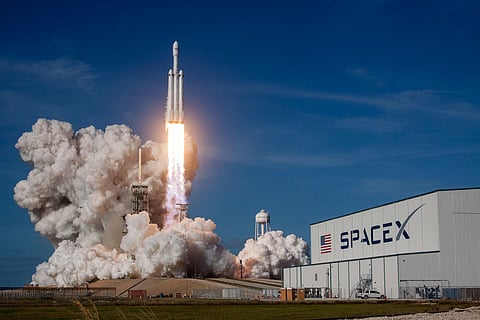


A four-tonne piece of a SpaceX rocket believed to have struck the moon early Wednesday has created an opportunity for scientists to study crater formation and lunar dust produced by a high-speed impact.
The school-bus-size object was expected to hit near Einstein Crater at about 2:35 a.m. Eastern time, travelling approximately 8,700 kilometres per hour and striking with the estimated force of three tonnes of TNT.
The debris was the second stage of a Falcon 9 rocket used to launch a Firefly Aerospace lunar lander in January 2025.
Unlike rocket stages that return through Earth’s atmosphere or fall into remote ocean areas, the stage remained in space after the lunar mission required additional thrust.
It had released its remaining fuel and could no longer be controlled.
Over roughly 18 months, solar activity and gravitational forces from the sun, Earth and moon gradually redirected the stage toward the lunar surface.
SpaceX described the resulting collision course as unintentional and said the vehicle lacked enough fuel to prevent the impact.
Spacecraft orbiting the moon were not positioned to record the collision live, leaving scientists to confirm and assess the event through later observations.
The impact was expected to produce a plume of lunar dust illuminated by sunlight, although the location on the moon’s western limb is often difficult to observe from Earth.
NASA’s Lunar Reconnaissance Orbiter and South Korea’s Danuri spacecraft adjusted their instruments to examine the impact area.
Their observations are expected to include high-resolution images taken before and after the collision, along with surveys of the dust plume and newly formed crater.
Bill Gray, an astronomy software developer who tracked the stage, said the impact posed no immediate danger but highlighted concerns about the disposal of leftover space hardware.
NASA and SpaceX are discussing methods to prevent similar lunar collisions in the future.
The event is believed to be the second accidental crash of discarded rocket debris into the moon.
A stage from a Chinese Long March 3C rocket struck the lunar far side in March 2022 and produced an unusual double crater.
NASA has also deliberately sent rocket stages into the moon during earlier research missions to examine lunar material and seismic effects.