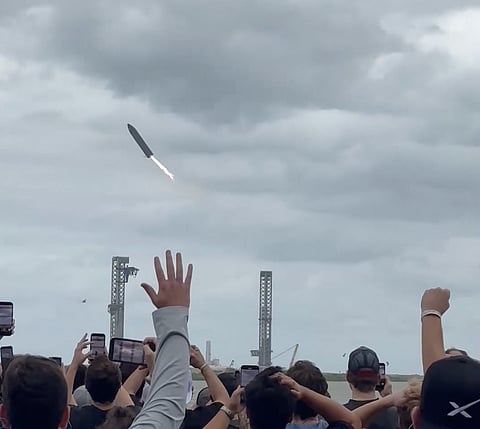


SpaceX's Starship upper stage returned to its Texas launch tower on Saturday after a 22-hour flight, where mechanical arms caught the spacecraft following 14 orbits of Earth.
The recovery fulfilled one part of a planned double catch after the rocket's Super Heavy booster exploded during its return on Friday.
Starship launched late Friday from SpaceX's Starbase facility near the US-Mexico border, using its first-stage booster to begin the ascent.
After separation, the upper stage entered orbit and released 26 Starlink satellites, according to AP, The Guardian and Al Jazeera.
Flying about 265 kilometres (165 miles) above Earth, the spacecraft completed 14 laps, compared with one to two on its preceding mission.
The flight was the 15th test of a full-scale Starship since 2023, according to AP.
SpaceX reported that the upper stage and its heat shield appeared to perform well.
The spacecraft descended upright through clouds above Launch Pad 2 before being held by the tower's mechanical arms.
The booster, meanwhile, was diverted into the Gulf of Mexico and destroyed.
SpaceX's Kate Tice said its engines stopped firing too soon during descent and its guidance system determined the vehicle was not positioned for a catch.
Engineers were still investigating the cause.
The Guardian reported that SpaceX chief executive Elon Musk also described the booster as slightly low on fuel.
The outcome highlighted a distinction in SpaceX's recovery programme: the company had previously caught three Super Heavy boosters, but Saturday's successful upper-stage recovery did not complete the planned simultaneous recovery of both stages.
SpaceX says recovering and reusing its rocket stages is central to reducing launch costs and increasing flight frequency.
NASA welcomed the spacecraft's return, with Administrator Jared Isaacman praising the achievement.
The agency has contracted SpaceX and Blue Origin to develop lunar landers for its Artemis programme.
AP reported that NASA's next Artemis mission will remain in Earth orbit for lunar-lander docking practice, while the agency is targeting a crewed lunar landing under Artemis IV as soon as 2028.
SpaceX also expects to begin Starship launches from Florida's Kennedy Space Center within the next few months, according to AP.