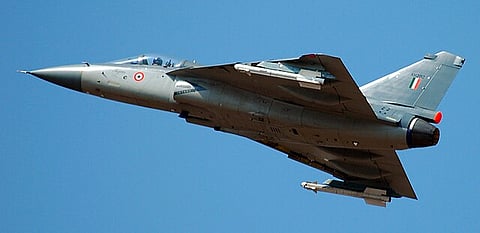


India's flagship Light Combat Aircraft (LCA) Tejas program has suffered its third major accident in less than two years, with a fighter jet crashing during landing at a forward airbase earlier this month. The incident, which occurred on February 7, 2026, involved a single-seat Tejas Mk-1 that sustained severe structural damage after running off the runway into a ditch following an apparent brake failure, according to defense establishment sources. The pilot ejected safely but sustained minor injuries, though the aircraft is likely to be written off entirely. This marks the third loss among the Indian Air Force's fleet of approximately 32 Tejas Mk-1 jets currently in service, raising questions about the platform's reliability and the program's troubled trajectory.
A Pattern of Catastrophic Failures
The February 2026 crash follows two earlier accidents that have marred the Tejas's operational record. The first occurred on March 12, 2024, near Jaisalmer in Rajasthan when a Tejas returning from a firepower demonstration crashed, though the pilot ejected safely. Far more devastating was the November 2025 crash during the Dubai Airshow, where Wing Commander Namansh Syal was killed when his aircraft entered an uncontrolled dive during a low-altitude aerobatic maneuver. Investigators noted that for the statically unstable Tejas platform, any delay in the fly-by-wire system under such conditions can prove fatal. The Dubai tragedy, witnessed live by thousands, dealt a severe blow to India's export ambitions and exposed the aircraft's handling vulnerabilities to the international community.
The Engine Crisis: Forty Years of Failure
At the heart of the Tejas program's chronic delays and performance shortcomings lies the catastrophic failure of India's indigenous Kaveri engine project, launched in 1986 with grand ambitions of achieving self-reliance. After nearly four decades of development, the Kaveri has never managed to produce sufficient thrust, while persistent issues with excessive weight, overheating, and lack of durability have rendered it unusable for the Tejas. The engine cannot even match standards set by Western designs from the 1970s, forcing India to rely entirely on American General Electric F404 and F414 powerplants. This dependency has proven crippling: during 2024-2025, the United States delayed F404 deliveries by more than two years due to supply chain disruptions, bringing Tejas production to a near standstill. HAL chairman DK Sunil has acknowledged that engine supply remains the single greatest constraint on production timelines.
Technical Deficiencies and Design Compromises
A damning report from India's Comptroller and Auditor General identified 53 major deficiencies in the Tejas Mk-1 version that significantly reduce its combat capability. The aircraft is heavier than originally designed, adversely affecting speed, maneuverability, and overall performance. Critical vulnerabilities include inadequate shielding for the cockpit and fuel systems, leaving pilots and vital components dangerously exposed. Perhaps most alarming, the aircraft's limited internal space prevented installation of an onboard electronic warfare self-defense system, meaning the Tejas lacks basic protective countermeasures expected of a modern fighter. Despite claims of 70% indigenous content, actual localization stands at merely 35%, with most critical systems sourced from foreign suppliers. The integration of Israeli ELTA EL/M-2052 radars on the Mk1A variant has created additional complications, as Israel retains software control and India's Astra Mk1 missile failed a critical test launch due to data synchronization issues with the radar.
Production Paralysis
After more than four decades since the LCA program was launched in 1983, only about 40 Tejas fighters have been inducted into the Indian Air Force, against a projected requirement of 325 aircraft. Two squadrons currently operate the Tejas Mk-1, while deliveries of the upgraded Mk1A variant are running nearly two years behind schedule despite orders for 180 aircraft. The glacial production rate has left the IAF dangerously depleted, with squadron strength falling to just 29 against an authorized strength of 42, as aging MiG-21, MiG-23, and MiG-27 units are retired faster than Tejas can replace them. Air Chief Marshal Amarpreet Singh has publicly expressed frustration that not a single defense project he can think of has been completed on time. The broader military aviation record compounds these concerns, with India having lost over 600 pilots in more than a thousand aircraft crashes over the decades, including approximately 468 MiG-21 accidents alone.