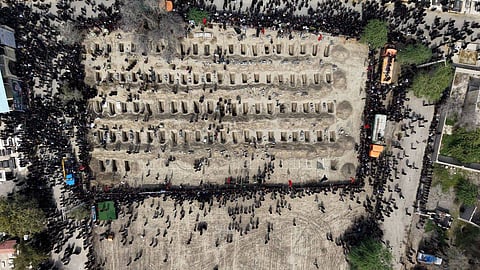


Independent reporting suggests that the ongoing bombing campaign in Iran has already produced significant civilian casualties. Rights organizations cited by international media estimate that more than one thousand civilians may have been killed since the strikes began, with many more injured. Among the most widely reported incidents is the destruction of a girls’ school in the city of Minab, an event that reportedly killed dozens of children and teachers. The circumstances of that strike remain under investigation, including whether U.S. forces were involved.
Civilian deaths in war are not unusual, but they demand explanation. The United States has long presented its military operations as technologically precise and guided by strict rules intended to limit civilian harm. Yet the public response to reports of casualties in Iran has been cautious and limited. Investigations may be underway, but detailed public accounting of what has happened on the ground remains scarce.
The Pentagon has stated that it is reviewing reports of civilian casualties, including the strike that destroyed the Minab school. This is consistent with how the U.S. military formally approaches allegations of civilian harm. Internal investigations are opened, damage assessments are conducted, and statements are released acknowledging that inquiries are ongoing.
But in practice, many of these investigations unfold largely out of public view. Findings often arrive months later, if at all, and frequently conclude that available evidence is inconclusive or that responsibility cannot be fully established. For observers and victims alike, the result can feel less like accountability and more like disappearance. Civilian deaths are acknowledged briefly, then gradually fade from the official narrative.
This dynamic has appeared repeatedly in past conflicts. During the wars in Iraq and Afghanistan, numerous airstrikes that killed civilians were initially denied or minimized before later investigations revealed a far higher human cost than early statements suggested.
At the same time, the public imagery surrounding the Iran campaign has emphasized a very different narrative. Military messaging from the United States and Israel has highlighted the effectiveness of strikes, the reach of advanced weapons systems, and the destruction of strategic targets. Footage released online often shows drone perspectives or distant missile impacts, images that convey technological control and operational success.
This style of communication is not new. During the 2003 invasion of Iraq, audiences around the world were introduced to the language of “precision warfare,” accompanied by night-vision footage of bombs striking buildings and targets from high altitude. Television broadcasts repeatedly showed these images as evidence of a modern, efficient campaign.
Yet what those images rarely showed were the consequences on the ground. Civilian casualties, damaged neighborhoods, and overwhelmed hospitals existed largely outside the frame. The war’s visual narrative emphasized accuracy and control, even as the broader human cost became increasingly clear over time.
The Iraq War also demonstrated how information management can shape public perception of conflict. During the invasion, hundreds of journalists were embedded with U.S. military units, a system that gave reporters close access to soldiers and operations but also tied their reporting to the perspective of the forces they accompanied. Much of the early coverage therefore focused on battlefield progress and military effectiveness.
Meanwhile, reporting on civilian casualties often struggled to gain the same visibility. The result was a media environment where images of advancing columns and precision strikes dominated the narrative, while the destruction experienced by Iraqi civilians appeared more sporadically.
This pattern matters because it shapes how wars are understood. When public attention is dominated by dramatic footage of strikes and narratives of technological dominance, the human cost becomes easier to overlook. Civilian deaths turn into statistics rather than central facts of the conflict.
The reports emerging from Iran suggest that this tension between presentation and reality is appearing once again. Governments emphasize operational success and strategic objectives. Rights groups and local reporting point to rising civilian casualties.
Both realities can exist at the same time. But if the second disappears from public attention, the picture of the war becomes dangerously incomplete.
War inevitably produces narratives, but responsible governments should confront its consequences openly. Civilian casualties cannot simply be investigated quietly and then allowed to fade from view. They deserve scrutiny, transparency, and acknowledgment, not a place beneath the spectacle of modern warfare.