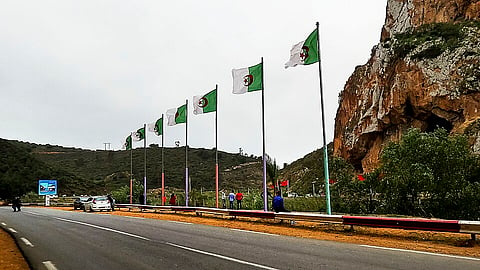


Algeria announced on Thursday that it was severing diplomatic relations with the United Arab Emirates, bringing five decades of formal ties to an abrupt end. The Algerian Foreign Ministry summoned UAE Ambassador Yousef Saif Khamis Subaa Al-Ali to its headquarters, informed him of the decision, and gave him 48 hours to leave the country. In a formal statement, Algiers accused Abu Dhabi of a series of "provocative or hostile" actions, stating that the UAE had "persisted in its excesses" and that its conduct had "reached limits that can no longer be considered acceptable or tolerable".
The ministry said the decision came "after exhausting all avenues capable of preserving bilateral relations". As a further measure, Algeria announced it would close its airspace to all UAE registered civilian and military aircraft from midnight on Friday, with the exception of commercial flights serving Algiers' Houari Boumediene International Airport, which will be permitted to continue until the end of 2026 when the current contract expires.
A Long Building Rift
The decision did not come out of nowhere. Tensions between the two countries had been escalating for years, driven by a complex web of regional rivalries that span from the Western Sahara to the Sahel and beyond. In October 2025, Algerian President Abdelmadjid Tebboune publicly stated that his country's relations with all Gulf states were warm except for one, a thinly veiled reference to the UAE, and accused the unnamed country of meddling in Algeria's internal affairs and seeking to destabilise it.
He would later refer to the UAE disparagingly as a "micro state" or "statelet" and, in a televised interview in July 2026, declared: "Wherever they set foot, blood flows". In February 2026, Algeria began the process of cancelling an air services agreement with the UAE that had been signed in Abu Dhabi in May 2013, a concrete step signalling that the dispute had moved beyond rhetoric into formal bilateral measures.
The Western Sahara and Israel Normalisation Fault Lines
One of the most fundamental divisions between Algiers and Abu Dhabi concerns the decades old dispute over Western Sahara. Algeria has long supported the Polisario Front, which seeks independence for the Sahrawi in the disputed territory, while the UAE has backed Morocco's claim to sovereignty, even maintaining a consulate there. This alignment places Algiers and Abu Dhabi on opposite sides of a conflict that has defined North African geopolitics for generations.
A further and equally significant divide stems from their divergent positions on Israel. Algeria firmly opposes normalisation of ties with Israel and has taken a strong pro-Palestinian position, while the UAE established diplomatic relations with Israel in 2020 under the US brokered Abraham Accords, alongside Morocco, Algeria's regional rival.
The Sahel
Beyond these specific disputes, the two countries' interests have clashed most sharply in the Sahel, the vast belt of countries south of the Sahara Desert. Algerian officials and state media have repeatedly accused the UAE of financing paramilitaries and interfering in the region to expand its influence and undermine Algeria's own interests. According to Geoff Porter, an analyst with North Africa Risk Consulting, "Algeria viewed the UAE's interference in North African and Sahelian affairs as not only contrary to Algeria's foreign policy principles, but as an indirect threat to Algerian security".
Among the specific grievances are Abu Dhabi's support for eastern Libyan military commander Khalifa Haftar, its backing of the Rapid Support Forces in Sudan, a militia accused of committing genocide and a drone base in Mauritania that neighbours Algeria. Andreas Krieg, an associate professor at King's College London, noted that Tebboune had spent the better part of a year railing against a "small state" bent on stirring trouble, and that "today he just stopped pretending it was anonymous".
The UAE's Response and Economic Considerations
The UAE responded cautiously, with its Foreign Ministry expressing hope that Algeria's decision would be "temporary" and affirming its appreciation for the "brotherly Algerian people". Anwar Gargash, diplomatic adviser to UAE President Sheikh Mohamed bin Zayed Al Nahyan, wrote on X that diplomatic relations should be based on "rationality, communication and clarity of interests" rather than "riddles and signals that require decoding".
Economically, the rupture carries significant implications. The total non oil trade between the two countries has ranged around $625 million annually in recent years, with Emirati exports to Algeria accounting for approximately 85 percent of the total, primarily consisting of re-exports, while Algerian exports, concentrated in food products and mining materials make up the remaining 15 to 20 percent. While a complete diplomatic break does not automatically nullify existing contracts, it could undermine prospects for cooperation in energy, infrastructure, finance and investment at a time when Algeria is seeking to attract foreign capital to diversify its economy beyond hydrocarbons. Algeria had already frozen a major Emirati investment in the water desalination sector in May, signalling that the dispute was beginning to affect economic relations.
A Regional Order in Flux
The severing of ties marks a significant escalation in the broader competition for influence across North Africa and the Sahel, a region that has become a critical arena for competing regional powers as political instability and military coups have transformed the security landscape. Algeria is a major non-NATO ally of the United States and has long positioned itself as a mediator in regional conflicts, from Mali to Libya. The UAE, meanwhile, has expanded its economic and political engagement across Africa, creating friction with Algeria's regional priorities.
The rupture between Algiers and Abu Dhabi also adds another layer of complexity to an already volatile regional environment, where the war in Gaza, the US-Iran conflict, and the collapse of Yemen's truce have all contributed to a period of profound instability. For now, the relationship that once linked Algiers and Abu Dhabi has been formally severed, and the diplomatic channels that might have bridged their differences have been closed.