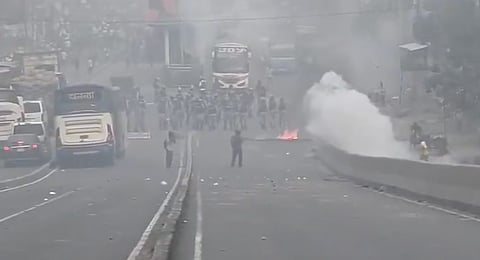


Bangladeshi police fired tear gas and stun grenades at thousands of garment workers on Tuesday as protests over wages intensified following the postponement of a wage board meeting.
Demonstrators threw bricks, set vehicles on fire and blocked the main highway connecting Dhaka and Mymensingh, according to AFP.
Workers are demanding a minimum monthly wage of 30,000 taka ($240), up from the 12,500-taka rate cited in the reports, representing a 140% increase.
They say rising food, housing, transport and healthcare costs have made higher wages necessary.
The government established a wage board comprising employer and worker representatives earlier this month to negotiate a pay increase.
A meeting scheduled for Monday was postponed after a worker representative said he was unwell, a source at the Bangladesh Garment Manufacturers and Exporters Association (BGMEA) told AFP.
The board said its next meeting would take place on November 23, with a revised minimum wage expected to be announced in December and implemented in January.
Garment worker Rakib, 28, expressed concern that workers' demands might not be reflected in the revised wage proposal.
"We want to return to our machines," he told AFP.
The BGMEA and Bangladesh Knitwear Manufacturers and Exporters Association (BKMEA) jointly called for wage negotiations to resume as soon as possible.
Sources told AFP that approximately 500 of Bangladesh's 4,500 garment factories were shut.
Rakib said most factories had initially opened on Tuesday before closing as demonstrations spread.
The shutdowns could also affect workers' immediate earnings.
Under Bangladesh's "no work, no pay" labour provision, factory owners can suspend operations and withhold wages when production is disrupted, leaving workers facing potential income losses while negotiations continue.
Tensions were also high in Savar and Ashulia, two garment production centres on the outskirts of Dhaka.
Border Guard Bangladesh (BGB) deployed hundreds of personnel across the industrial zone following the demonstrations.
The force said it was monitoring protests using drones, body-worn cameras and other surveillance equipment.
Bangladesh's garment industry generates approximately $38 billion annually and employs more than four million people, according to AFP.
The United States is its largest individual market, while the European Union is its largest trading bloc.