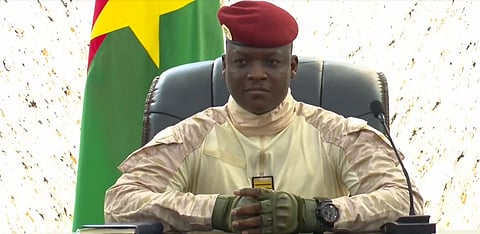


Burkina Faso’s military government has formally banned all political parties, deepening its consolidation of power more than two years after seizing control in a coup.
The decision, announced by authorities in Ouagadougou, converts earlier suspensions into a full dissolution of party activity and transfers party assets to the state.
The move has intensified debate inside the country and abroad over the future of democracy, governance, and civil liberties in the West African nation.
Interior Minister Emile Zerbo said the ban was part of an effort to “rebuild the state” after what he described as widespread abuses within the multiparty system.
He argued that the proliferation of political parties had fueled social divisions and weakened national cohesion.
Under the new decree, all laws regulating political parties have been scrapped, effectively ending their legal existence.
Before the 2022 coup, Burkina Faso had more than 100 registered parties, with 15 represented in parliament following the 2020 elections.
Political gatherings had already been prohibited since the military takeover, but the latest step eliminates party operations entirely.
A draft law formalizing the transfer of party assets to the state is expected to be sent to the Transitional Legislative Assembly.
The ban has drawn criticism from civil society groups and analysts who see it as part of a broader contraction of civic space.
One civil society member told the BBC, “This will not help the country move forward. We're not happy with this.”
Captain Ibrahim Traoré, who took power in September 2022 after a series of coups, had pledged to restore civilian rule by mid-2024 but later extended the transition by five years.
His government has faced accusations of suppressing dissent, restricting media access, and exerting greater control over the judiciary.
At the same time, some supporters have welcomed the decision, arguing that political fragmentation had encouraged corruption and instability.
The ban unfolds amid persistent insecurity, regional realignments with Mali and Niger, and Burkina Faso’s growing distance from Western partners.