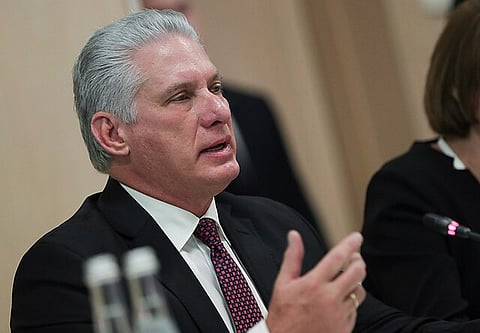


In a firm defense of national sovereignty, Cuban President Miguel Díaz-Canel has stated there are no substantive talks with the United States, directly countering claims by U.S. President Donald Trump. The statement comes amid escalating threats from Washington, which has moved to sever Cuba's economic lifelines in what experts describe as a campaign of maximum pressure aimed at forcing political capitulation.
The confrontation intensified when President Trump issued an ultimatum to the Cuban government, declaring, "THERE WILL BE NO MORE OIL OR MONEY GOING TO CUBA - ZERO!" and demanding Havana "make a deal, BEFORE IT IS TOO LATE". He provided no details on the terms of this supposed deal, framing it as a non-negotiable demand following a U.S. military raid in Venezuela that toppled Cuba's ally, President Nicolás Maduro. In response, President Díaz-Canel made Cuba's position unequivocal: "We have no conversations with the U.S. government except for technical contacts in the area of migration". He emphasized that any genuine dialogue must be based on "international law rather than hostility, threats, and economic coercion".
The U.S. strategy explicitly aims to deepen Cuba's severe economic crisis by cutting off its primary source of oil. Before the raid on Venezuela, Cuba received an estimated 35,000 barrels per day from its ally, covering roughly half of its oil deficit. The loss of this supply exacerbates existing humanitarian hardships, including widespread blackouts, severe shortages of food and medicine, and a crumbling electrical grid. The Cuban government states that U.S. sanctions have cost the country over $7.5 billion in just the last year.
The aggression also carries a direct human toll. The Cuban government reported that 32 of its military and intelligence personnel were killed "in combat actions" during the U.S. operation in Caracas. President Díaz-Canel condemned the moral hypocrisy of the threats, stating that "those who turn everything into a business, even human lives, have no moral authority to point the finger at Cuba".
Cuba's leadership frames the current threat as a continuation of a 66-year history of U.S. aggression against the island's sovereignty. "Cuba is a free, independent, and sovereign nation. Nobody dictates what we do," Díaz-Canel asserted. Foreign Minister Bruno Rodríguez echoed this, accusing the United States of behaving "like an out-of-control criminal hegemon that threatens peace and security". This stance of defiance is rooted in a long-standing policy. Even during a previous period of U.S. diplomatic engagement under President Barack Obama, Cuba maintained its right to self-determination without preconditions.
The current U.S. administration has made its ambitions clear, reinstating a hardline policy to economically strangle the Cuban state. Top officials, including Secretary of State Marco Rubio, who is openly supported by Trump for a future role in Cuba have predicted the recent intervention would push the island "over the edge". However, faced with what it calls "economic warfare," the Cuban government and many of its citizens express resolve. "The Cuban people are prepared for anything," said Havana resident Luis Alberto Jimenez, capturing a national sentiment of resistance.