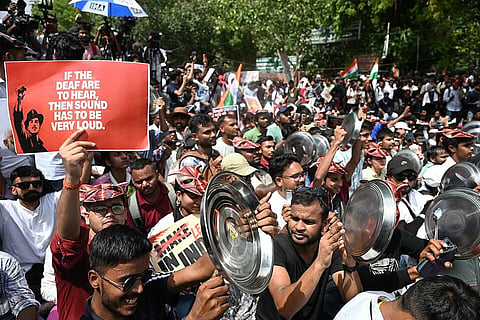


The streets of central Delhi have become a crucible of youthful fury, as tens of thousands of Gen Z protesters, galvanized by the irreverent Cockroach Janta Party (CJP), continue their relentless sit in at Jantar Mantar. For over a month, these young men and women have faced tear gas, baton charges, and a government imposed information blackout to demand the resignation of Education Minister Dharmendra Pradhan. Their anger is rooted in a scandal that has shaken the very foundations of India's educational system: the mass leakage of the National Eligibility cum Entrance Test (NEET) medical entrance exam paper, which shattered the dreams of roughly 2.28 million students.
What began as a satirical online movement has morphed into the most significant political challenge to Prime Minister Narendra Modi’s rule since 2014, exposing a deep seated rot in the country's governance and the government's contempt for the voices of its youth.
The immediate catalyst for the protests was the leak of the NEET paper in May, a catastrophic failure that forced millions of students to retake an exam they had spent years preparing for. This was not an isolated incident but the latest in a long string of examination irregularities that have plagued the Modi administration. Over the past decade, a staggering 152 examination papers have been leaked, yet not a single conviction has been secured.
The scandal has been directly linked to at least 20 student suicides, a grim testament to the devastating human cost of this systemic corruption. For the young protesters, the paper leak is not a bureaucratic failure but a profound betrayal by a government that has promised them a future, only to watch their aspirations be destroyed by a mafia of corrupt officials and middlemen.
Instead of addressing the root causes of the crisis or holding the Education Minister accountable, the Modi government has responded with a heavy handed crackdown reminiscent of an authoritarian state. The administration has resorted to draconian measures to suppress dissent, including shutting down 16 metro stations in central Delhi, cutting off mobile internet services for days on end, and ordering businesses in the bustling Connaught Place area to close early. This information blockade has not only crippled the protesters' ability to organize but has also paralyzed thousands of local businesses and commuters.
The Congress party has accused the government of treating peaceful demonstrators like terrorists, with senior leader K.C. Venugopal stating that the administration is "turning Delhi into a war zone". The internet shutdown has been in effect for days without any official order from the Ministry of Home Affairs.
The refusal of Prime Minister Narendra Modi to sack Education Minister Dharmendra Pradhan is an illustration of the ruling Bharatiya Janata Party’s (BJP) culture of impunity. The CJP and the opposition Congress party have both pointed out that Pradhan's continuation in office is a direct insult to the students and their families. Modi’s recent video message, in which he promised fast track courts to punish the guilty, has been widely dismissed as a "distraction" and a "half-measure" by the protesters, who are demanding genuine accountability rather than theatrical gestures.
Congress leader Rahul Gandhi has articulated the opposition's stance: "No talks until Pradhan resigns, and the Prime Minister apologises for the police brutality against the students". The government's attempt to hold talks with the CJP at a minister's residence, which was rejected by the protesters as a sign of bad faith, further illustrates the administration's reluctance to engage on equal terms.
The Congress party, led by Rahul Gandhi, has been there in its support for the student movement, staging a symbolic march to Gandhi Smriti and carrying copies of the Constitution to highlight the government's authoritarian overreach. Gandhi has accused Modi of destroying the future of India's youth and has demanded that the Home Minister, Amit Shah, who controls the Delhi Police, also resign for unleashing state violence on peaceful protesters.
The party has repeatedly disrupted the monsoon session of parliament, insisting that the government cannot avoid a debate on the issue by simply muzzling dissent. However, it is the CJP that remains the heart of the movement, embodying the spirit of defiance and the refusal to be silenced. As one CJP spokesperson put it, "We are not backing out because real awakening starts from the grassroots".
The protests in Delhi have struck a chord far beyond the capital, spreading to cities like Ranchi, Pune, Thiruvananthapuram, and Kolkata. The movement, which emerged as a sarcastic response to a Supreme Court judge comparing unemployed youth to "cockroaches," has now become a powerful symbol of resistance against a government that seems to view its young population as a nuisance rather than a national asset.
With the monsoon session of parliament in turmoil and the Modi government facing one of its most serious political crises, the future remains uncertain.