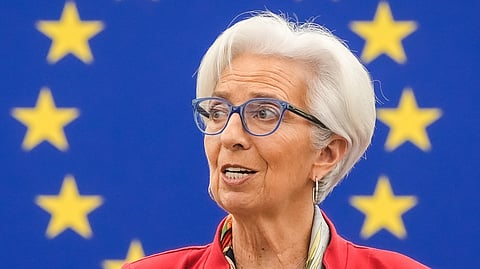


European Central Bank President Christine Lagarde announced her resignation on Thursday, October 29, confirming she will leave office on February 7, 2027, nine months before her term expires.
The departure comes as the eurozone faces weak growth, renewed inflationary pressures and rising government borrowing costs, while European leaders prepare for politically consequential elections in France.
Political Implications and Succession
Lagarde's early exit allows European Union leaders to select her successor before France's presidential election in April and May 2027, where far-right politician Marine Le Pen is considered a leading contender.
A source familiar with the decision told Reuters that Lagarde wanted greater freedom to engage in political matters in France and internationally, activities constrained by the ECB presidency's neutrality requirements.
French President Emmanuel Macron called for an orderly, balanced succession process coordinated with European partners.
European Council President Antonio Costa confirmed that the selection process would begin immediately.
Potential successors include former Dutch central bank governor Klaas Knot, former Spanish central banker Pablo Hernández de Cos, Germany's Joachim Nagel and European Investment Bank President Nadia Calviño.
The resignation drew contrasting reactions, with some European politicians questioning its timing and others arguing that it would protect the institution's independence.
Lagarde's departure coincides with mounting economic challenges stemming from an oil-price shock linked to the Iran war and rising bond yields, particularly in heavily indebted France.
Higher energy costs threaten to sustain inflation, while increasing borrowing expenses risk further weakening economic growth across the eurozone.
The ECB held interest rates unchanged on Thursday, warning that energy prices posed additional inflationary risks and threatened growth.
Markets anticipate further monetary tightening, potentially beginning in December, with expectations of three additional increases by the end of 2027.
Financial markets reacted relatively calmly to Lagarde's announcement, reflecting confidence in the ECB's institutional continuity.
Lagarde, who assumed office in 2019, previously led the International Monetary Fund and served as France's finance minister.
Her future remains uncertain, although she has been mentioned as a potential candidate to lead the World Economic Forum.