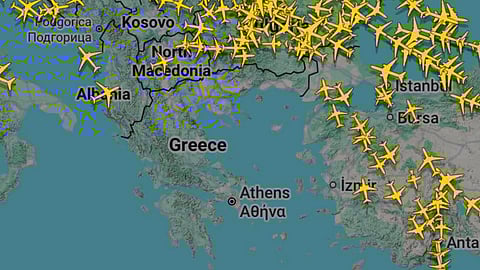


Flights across Greece were grounded for several hours on Sunday after a collapse of radio frequencies disrupted air traffic communications.
The outage stranded thousands of passengers and brought airport operations to a near standstill during the final weekend of the holiday period.
Authorities said the disruption began early in the day and escalated quickly, affecting departures and arrivals nationwide.
While some overflights continued under restrictions, most airport operations were suspended as officials assessed the situation.
Athens International Airport was among the worst affected, with more than 90 flights disrupted in and out of the capital.
Thessaloniki airport closed entirely, while flights at regional airports faced delays and cancellations.
Inbound flights were instructed to divert, return to their origin, or remain on standby, with many diverted to Turkey.
Passengers departing from cities including Dublin, Barcelona, and Paris were ordered to return mid-journey.
The timing raised concerns among travelers about returning home before the start of the working week.
Some passengers reported confusion and limited information from airport staff during the disruption.
By Sunday afternoon, limited services resumed after pilots switched to backup radio frequencies.
Greek authorities said departures gradually increased, reaching up to 45 flights per hour by late afternoon.
Inbound flights, however, continued to face restrictions as safety procedures remained in place.
Panagiotis Psarros, head of the Association of Greek Air Traffic Controllers, said, "We could not communicate with aircraft in the sky."
The association described the incident as unprecedented and said it affected all ground frequencies and some used for Athens approach control.
Initial assessments suggested a possible antenna failure near Athens, though the exact cause remained unclear.
Italy, Turkey, and Cyprus assisted Greece in managing air traffic during the disruption.