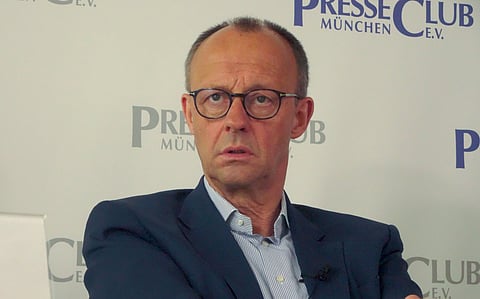


German Chancellor Friedrich Merz warned Friday that the global rules-based order “no longer exists” and that U.S. leadership can no longer be assumed, delivering a stark message at the opening of the Munich Security Conference.
Addressing dozens of world leaders, Merz said Europe faces a new era of power politics in which “our freedom is no longer simply guaranteed” and must prepare to shoulder greater responsibility for its own security.
His remarks come amid mounting transatlantic tensions, including U.S. President Donald Trump’s tariff policies and renewed threats to annex Greenland, a Danish territory.
Merz described a widening political and economic rift between Europe and the United States, saying “a deep divide has opened between Europe and the United States.”
He pointed to disagreements over trade, democratic norms and ideological debates, arguing that Europe does not share Washington’s embrace of tariffs and protectionism.
Trump, speaking outside the White House, said: “Greenland's gonna want us... We get along very well with Europe. We'll see how it works out. We're negotiating right now for Greenland.”
The issue has heightened concerns among European leaders about U.S. commitments to NATO and the durability of the American security umbrella.
U.S. Deputy Defense Secretary Elbridge Colby called for a “NATO 3.0,” urging European allies to assume a greater share of defense responsibilities, while Secretary of State Marco Rubio described a “new era in geopolitics.”
Against that backdrop, Merz confirmed confidential discussions with French President Emmanuel Macron about a potential European nuclear deterrent.
France and the United Kingdom are Europe’s only nuclear powers, while Germany has traditionally relied on U.S. protection within NATO.
Merz said Germany remains anchored in the alliance but is preparing for scenarios in which American guarantees may be less reliable.
He reiterated Berlin’s support for Ukraine, stating: “This war will only end when Russia is at least economically, potentially militarily, exhausted.”
Macron later urged Europe to accelerate rearmament and strengthen unity, calling the war in Ukraine an existential challenge for the continent.
Merz concluded that Europe must adapt to a harsher geopolitical landscape shaped by rivalry with Russia and China, while seeking to “repair and revive transatlantic trust.”