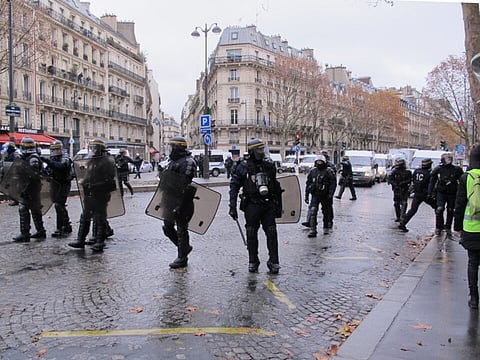


A recurring shadow of violence has once again fallen over the streets of Paris, marring what should have been a night of unbridled joy for Paris Saint-Germain fans. The team’s dramatic penalty shootout victory in the UEFA Champions League final was celebrated by tens of thousands who poured onto the iconic Champs-Élysées, but the jubilation quickly soured as riots erupted across the capital. Police clashed with supporters, fires were lit, shops were ransacked, and traffic on the city’s ring road was brought to a halt by a group who set off flares.
The scenes were a stark and violent echo of the chaos that followed PSG’s maiden European title just a year earlier, prompting a massive police deployment and raising a familiar, troubling question: why does football success so often lead to civil disorder in the heart of France?
The trouble began as soon as the final whistle blew in Budapest, where PSG secured a 4-2 win on penalties in a tense, high-stakes final. News of the victory spread like wildfire through the French capital, drawing an estimated 20,000 fans to the Champs-Élysées. The authorities, fearing a repeat of the previous year’s mayhem, had already taken extensive precautions. The interior ministry dispatched a staggering 22,000 police officers nationwide, including 8,000 in Paris. Tram lines were halted, metro stations were shuttered, and bus traffic was suspended in several areas in an attempt to control the crowd and minimise disturbances. However, the security cordon did little to prevent the descent into chaos.
By the end of the night, the interior ministry announced that 416 people had been detained across France, with the vast majority, 283, taken into custody in Paris. According to reports from the scene, clashes were particularly intense near the Parc des Princes stadium, where 4,000 to 5,000 people loitered outside, throwing projectiles at officers. Police responded with tear gas after fireworks were thrown at them. A group of supporters stormed the Paris ring road, the périphérique, halting traffic and setting off flares. A bakery, a restaurant, and a bus shelter were damaged, and six vehicles and two businesses were vandalised. Seven police officers were wounded in the unrest.
Adding to the volatile mix, the evening was already saturated with major events. Singer Aya Nakamura was performing at the Stade de France, rapper Damso was at the La Défense Arena, and the French Open tennis tournament was in full swing, stretching the city’s security resources to their limit.
This year’s violence was not an isolated incident but a frighteningly familiar pattern. The previous year, PSG’s first ever Champions League victory had triggered far more devastating riots. In the chaos of May 2025, more than 500 people were arrested across France, and nearly 200 were injured. The destruction was widespread, with over 200 cars set alight, entire neighbourhoods effectively handed over to rioters, and, most tragically, two people lost their lives, including a 17 year old boy.
The memory of that night, which left 192 people injured (including 22 police officers and 7 firefighters) and saw 692 fires recorded, loomed large over Saturday’s events. It was the primary reason for the unprecedented security presence that had been mobilised. The recurrence of violence, despite these massive precautions, suggests that a deeper social pathology is at play.
France has a long and uneasy history with football related violence that extends far beyond the celebrations of a single club. Some of the most notorious incidents have occurred on the national stage. During the 1998 World Cup, a tournament France hosted and ultimately won, the party was repeatedly interrupted by hooliganism. In the days leading up to the final, dozens of youths from Paris’s immigrant suburbs descended on the Champs-Élysées, hurling beer bottles and breaking windows. Earlier in the tournament, the southern city of Marseille became a battleground as British fans clashed with locals and police during England’s opening match against Tunisia.
More recently, the 2016 European Championship, also held in France, was marred by some of the worst hooliganism the continent had seen in decades. Riot police battled with fans on the Champs-Élysées after France’s qualification for the final, and the final itself ended with the Eiffel Tower being closed after its base was engulfed in clouds of tear gas.
The problem of football-related violence is by no means unique to France. Throughout Europe, the game has repeatedly been tarnished by the ugly spectre of hooliganism. The darkest day in the sport’s history remains the Heysel Stadium disaster in 1985, where 39 football fans, mostly Italians, lost their lives before a European Cup final in Brussels when a wall collapsed as Liverpool supporters attacked Juventus fans. English clubs were subsequently banned from European competition for five years. In the Netherlands, the fierce rivalry between Ajax and Feyenoord has long been a catalyst for organised violence.
In 1997, a group of Feyenoord hooligans were convicted of attacking a group of Ajax fans at a motorway service station. One of the most infamous incidents in Dutch football history is the 1989 De Meer nail bombs incident, where a Feyenoord hooligan threw two homemade nail bombs into the Ajax crowd during a match, injuring 19 people.
The day after the riots, the players themselves were scheduled to take part in a victory parade on the Champ de Mars, in front of the Eiffel Tower, an event expected to draw 100,000 fans. They were later to be received by President Emmanuel Macron at the Élysée Palace. However, the spectre of Saturday’s violence will undoubtedly hang over the festivities. The scenes prompted a furious response from the French far right, with Marine Le Pen writing on social media that "only in France does a football club’s victory spark riots."
The debate will continue over whether the root cause lies in systemic failures of policing, deep-seated social inequality, or the toxic influence of a small minority of violent individuals. Until a solution is found, the cycle of triumph followed by fire and fury seems destined to repeat, ensuring that for every great victory, there is an equally great cost in the streets of the nation’s capital.