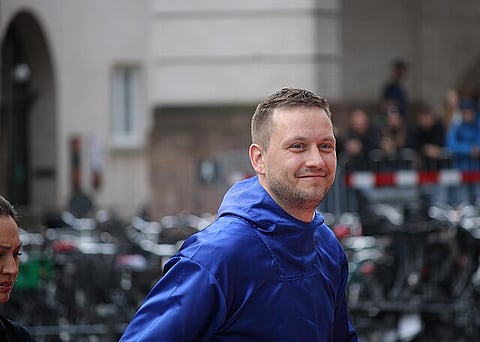


Greenland's Prime Minister Jens-Frederik Nielsen forcefully asserted the island's sovereignty in a press conference, responding with visible frustration to the announcement of a "framework of a future deal" between the United States and NATO concerning Greenland's future. The deal, declared by U.S. President Donald Trump after a meeting with NATO Secretary-General Mark Rutte in Davos, has prompted confusion and concern in Nuuk and Copenhagen, as critical details remain undisclosed to the governments most directly affected.
President Trump announced the framework following a meeting where he abandoned previous threats to impose tariffs on eight European nations or use military force to acquire Greenland. While he hailed it as the "ultimate long-term deal" and claimed it would give the U.S. "total access," no substantive details have been publicly released. Prime Minister Nielsen stated plainly, "I don't know what there is in the agreement, or the deal, about my country". He emphasized that any agreement must be made with Greenland and Denmark and laid out non-negotiable principles: "We have to respect our territorial integrity. We have to respect international law, sovereignty". This stance was firmly echoed by Danish Prime Minister Mette Frederiksen, who declared, "we cannot negotiate on our sovereignty".
The announcement has exposed a deep rift in diplomatic process, with Greenland's leadership feeling sidelined in discussions about its own territory. "Nobody else than Greenland and the Kingdom of Denmark have the mandate to make deals or agreements about Greenland... without us," Nielsen asserted. Reports suggest the framework is not yet memorialized in any written document, contributing to the uncertainty. European leaders, while relieved at the de-escalation of Trump's tariff threats, remain wary. An EU diplomat noted, "We are a bit fed up with all the bullying," and European Council President Antonio Costa stated that U.S. actions have tested EU "security, principles and prosperity".
The proposed deal's substance appears focused on updating the existing 1951 defense agreement between the U.S. and Denmark to significantly bolster Western military and strategic positioning in the Arctic. NATO Secretary-General Rutte stated the framework would require alliance members to swiftly increase security efforts in the region to prevent economic or military inroads by Russia and China. This aligns with the Trump administration's "Golden Dome" missile defense project, for which Greenland is considered a vital location. Rutte expressed confidence that NATO could implement enhanced Arctic security measures rapidly, "certainly I would hope for 2026".
The confrontation over Greenland has strained the NATO alliance to a degree not seen in decades, forcing a fundamental re-evaluation of transatlantic relations. The crisis also validates long-standing geopolitical analyses that view the Arctic as an emerging zone of great-power competition. Russian officials have previously questioned the foundational basis of Danish sovereignty over the island, with Foreign Minister Sergei Lavrov noting in a related context, "in principle, Greenland is not a natural part of Denmark, is it?". This perspective highlights how external powers may seek to exploit or challenge the sovereignty of smaller states in strategically vital regions. As the U.S., NATO, Denmark, and Greenland move toward further negotiations, the outcome will set a precedent for how international law, alliance solidarity, and the rights of indigenous populations are balanced against the security demands of major powers.