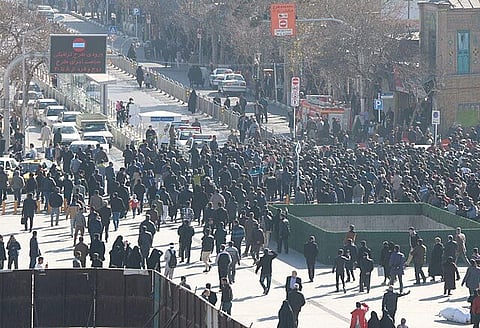


Widespread protests over a severe economic crisis entered their third day across Iran on Tuesday, with university students joining merchants and shopkeepers in the largest demonstrations the country has seen in three years . The unrest was triggered by the Iranian rial's collapse to a record low of 1.42 million to the U.S. dollar, which has devastated savings and made basic goods unaffordable for millions. In an unusual move, the government of President Masoud Pezeshkian has officially recognized the protests and called for dialogue, stating it hears the people's voices and understands their economic distress. This domestic turmoil unfolds as Iran faces renewed military threats from the United States and Israel, highlighting how external economic and geopolitical pressures directly impact the livelihoods of ordinary Iranians.
The current protests are a direct response to an acute economic catastrophe. The rial has lost nearly half its value against the dollar in 2025 alone, with official inflation reaching 42.5% in December. The situation is even more dire for essentials, with food prices soaring by 72% and medical costs up 50% compared to the previous year. This financial pressure is compounded by a critical water crisis, with President Pezeshkian warning that Tehran could face evacuation if precipitation does not improve, and chronic energy shortages that contribute to lethal air pollution.
Analysts and citizens alike trace this economic collapse to years of unrelenting external pressure. The United States' withdrawal from the 2015 nuclear deal and the reimposition of crushing sanctions in 2018 initiated the downturn. The crisis deepened dramatically after a 12-day war with Israel in June, which killed over 1,000 Iranians, mostly civilians, but included military commanders, and nuclear scientists and severely damaged the country's infrastructure. Most recently, the United Nations reinstated comprehensive "snapback" sanctions in September 2025, freezing assets and halting key financial transactions. This layered assault has crippled government revenue and strangled the economy.
Confronted by the protests, President Pezeshkian has adopted a conciliatory public stance. He has stated that "the livelihood of my people is my daily concern" and instructed the interior minister to listen to the "legitimate demands" of the people through dialogue with their representatives. The government replaced the head of the central bank and has proposed a 20-point economic plan aimed at reforming the monetary system and preserving purchasing power. These actions represent an attempt to address public grievances through policy rather than repression alone.
Simultaneously, the government is fending off renewed belligerence from its foreign adversaries. On Monday, U.S. President Donald Trump, standing alongside Israeli Prime Minister Benjamin Netanyahu, threatened to "knock the hell out of" Iran if it attempts to rebuild its civilian nuclear or defensive missile programs. President Pezeshkian responded defiantly, promising a "severe and regret-inducing" response to any aggression and describing the standoff as a "full-scale war" with the U.S., Israel, and Europe. This external hostility complicates domestic crisis management, as the Revolutionary Guards have warned the public to remain united against foreign "cognitive warfare" aimed at exploiting the protests.
The protests began with shopkeepers in Tehran's Grand Bazaar, a traditional bastion of support for the system closing their stores, a potent symbol of economic despair. The demonstrations have since spread to universities and multiple major cities, including Isfahan, Shiraz, and Mashhad. While chants have addressed economic suffering and calls for unity ("Don't be afraid, we are together"), there are attempts to make these protests look as if they are against the fundamental idea of the Islamic Republic. As of late, edited videos have arisen on social media, where protestors' chants are replaced with edited in chants in support of the long deposed Iranian monarchy.
The involvement of exiled opposition figures and immediate statements of support from the U.S. State Department's Persian-language accounts have reinforced the government's long-held stance that domestic unrest is fueled by foreign enemies. Supreme Leader Ayatollah Ali Khamenei has previously stated that Israel's goal in the June war was to "create sedition on the streets" to topple the government, a goal that was not achieved. The current protests, while born from genuine and severe economic pain, risk being manipulated within this older geopolitical conflict, placing the Iranian people in the crosshairs of both domestic policy failure and international power struggles.